
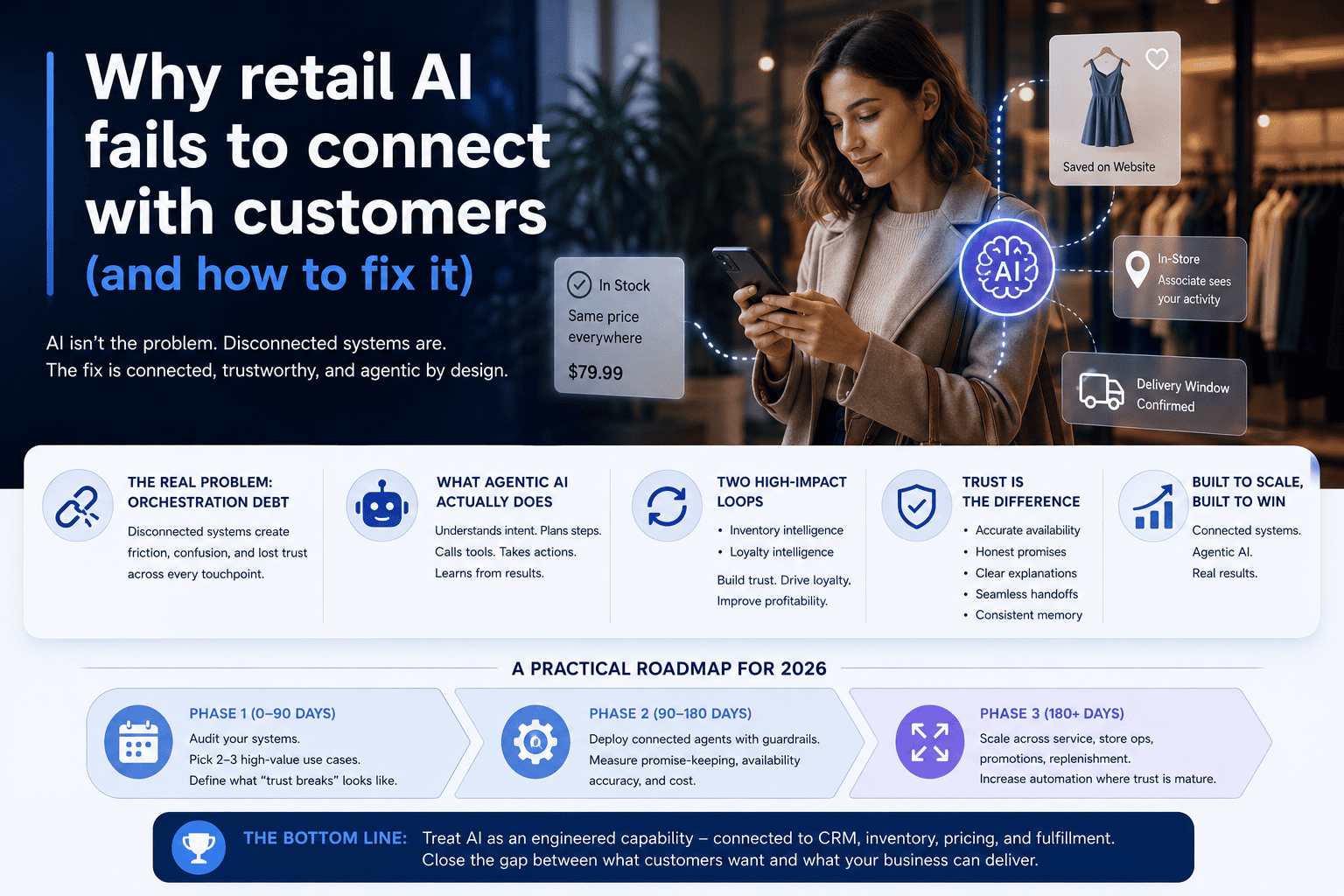
Why retail AI fails to connect with customers (and how to fix it)
Most retailers think they offer omnichannel shopping. They have a website, an app, stores, loyalty programs. But the customer doesn’t feel remembered. She saves a dress on the website, opens the app on the train – and nothing carries over. In the store, the associate can’t see what she looked at. Availability and prices change across channels. The brand has no real memory.
This is still true in 2026. AI is everywhere, but the seams between channels keep breaking. The real problem isn’t technology – it’s architecture.
The hidden cost: “orchestration debt”
When you add smart features in separate silos, you create orchestration debt. It shows up as:
- A recommendation engine suggesting items that are out of stock
- Customer service not seeing what happened in the app, so the shopper repeats everything
- Promotions calculated differently across systems, causing price confusion
- Marketing and inventory teams working on different timelines
The customer doesn’t feel clumsy technology. They feel dishonesty.
What agentic AI actually does (and doesn’t)
Agentic AI is not a smarter chatbot. It’s a system that:
- Understands intent
- Plans steps to reach a goal
- Calls tools across the business
- Takes actions (within limits)
- Learns from results
In retail, this means handling moments like: “Find a dress for my occasion, size, budget, and delivery window” – and actually making it happen.
The best agents don’t just reply. They read operational signals (inventory risk, delivery problems, pricing conflicts) and fix issues before the customer notices.
Two high-impact loops
Most practical retail agents focus on two things:
- Inventory intelligence – reducing stockouts and overstock, making sure offers are “inventory-aware.” Availability accuracy is trust.
- Loyalty intelligence – detecting when customers are about to leave and triggering retention journeys. Turning AI into a loyalty engine, not just a marketing engine.
Why most retail AI fails before it scales
One reason: the agent can’t see what’s true. If it can’t check real-time inventory, it will recommend unavailable items. If it can’t check delivery capacity, it will promise impossible windows. If pricing and promotions are disconnected, it creates chaos.
Customers and store staff also need to trust the AI. Trust comes from:
- Never recommending what can’t be delivered
- Honest delivery promises, not best-case optimism
- Simple explanations (“I chose this because it matches your budget and size”)
- Graceful handoff to a human with full context
- Consistent memory across channels
A practical roadmap for 2026
- Phase 1 (0–90 days): Audit your systems. Pick 2–3 high-value use cases. Define what “trust breaks” looks like.
- Phase 2 (90–180 days): Deploy connected agents with guardrails. Measure promise-keeping, availability accuracy, and cost.
- Phase 3 (180+ days): Scale across service, store ops, promotions, replenishment. Increase automation where trust is mature.
The bottom line
Retailers who treat AI as a series of pilots will stay stuck. Those who treat AI as an engineered capability – connected to CRM, inventory, pricing, and fulfillment – will close the gap between what customers want and what the business can deliver. That’s the winning advantage in 2026.
SeFFkA
May 18, 2026“Orchestration debt” is a brilliant term. Most retailers don’t realize they’re accumulating it – each new AI feature adds complexity without integration. The result feels dishonest to customers, even though no one intended to lie.
Barsen
May 19, 2026Availability accuracy is trust. This is the single most practical insight. Recommending an item that’s actually out of stock doesn’t just annoy – it breaks the relationship immediately. Inventory intelligence isn’t just ops; it’s customer experience.
Catsusiro
May 23, 2026The roadmap is refreshingly non-hyped. Phase 1 is “audit where truth breaks” – not “buy a giant AI platform.” That’s how real transformation starts: with honesty about what’s already broken.