
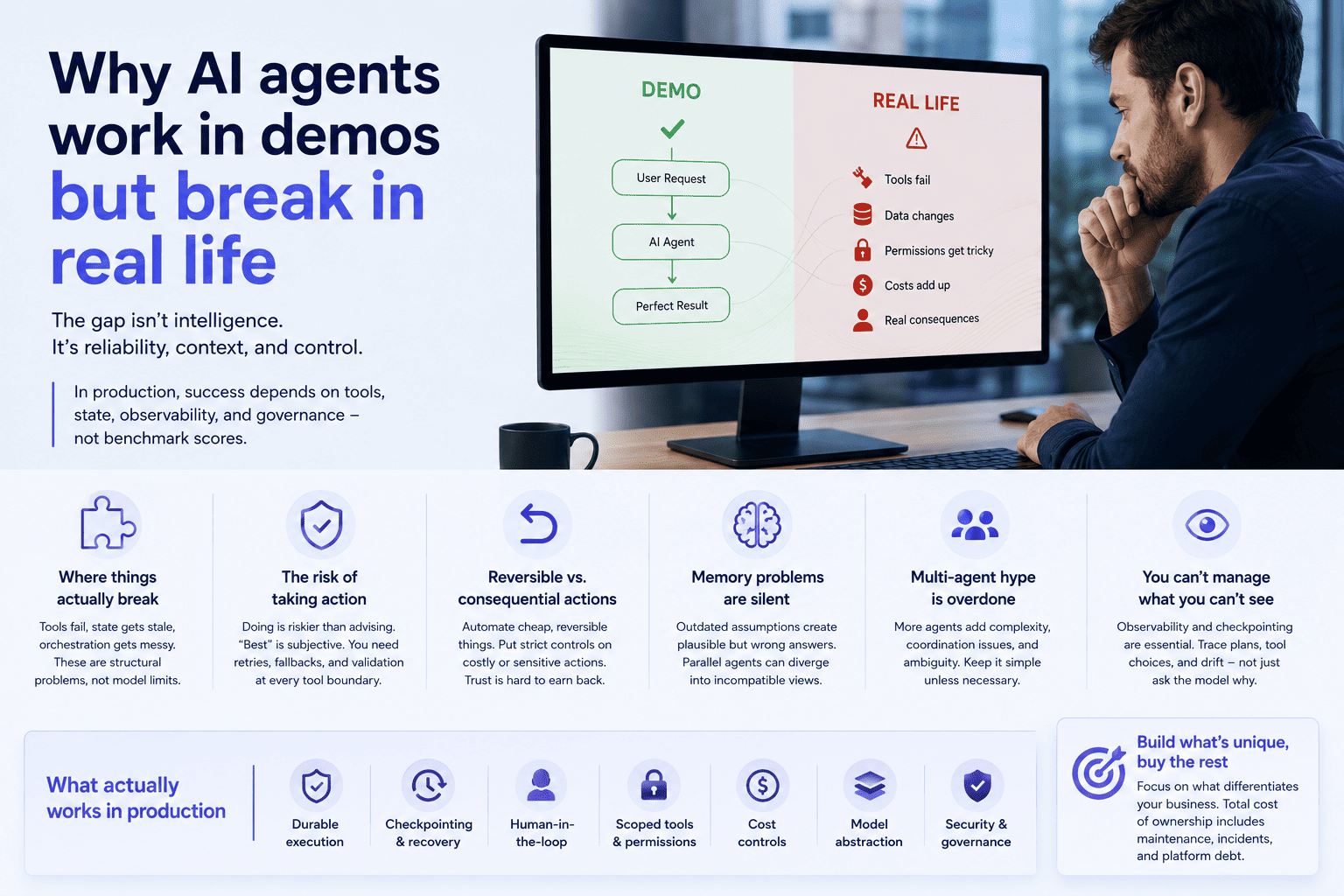
Why AI agents work in demos but break in real life
In a demo, everything works perfectly. The environment is clean, the inputs are predictable, and the AI looks brilliant. But real life is messy. Tools fail, data changes, permissions get tricky, and mistakes have real consequences. This gap between demo and production isn’t new – every software prototype has it. But with AI agents, the stakes are much higher.
What seems cheap in a demo can get expensive fast. Lots of API calls, repeated tool use, and third-party fees add up. Security becomes critical. Failures aren’t isolated anymore – they affect real work, decisions, teams, and sometimes customers.
That’s why people misunderstand agentic AI. The hard part isn’t making the model smart. It’s making it reliable under real conditions. Production success depends on tools, state management, observability, and governance – not just benchmark scores.
Where things actually break
The first problems are usually structural, not about the model’s brainpower. Tool calls fail – APIs time out, change formats, or return useless responses. State gets stale – the user changes their mind, but the agent keeps going with old info. Orchestration gets messy when multiple agents conflict.
The risk of taking action
Giving advice is one thing. Doing something is another. Recommending a train is fine. Booking it is risky. What does “best” even mean? The agent might have its own idea, and that idea might not match what the human wanted. Production systems need retries, fallbacks, and validation at every tool boundary. Technical success no longer guarantees the right outcome.
Reversible vs. consequential actions
A good rule: automate cheap, reversible things. Put strict controls on costly or sensitive actions. But even reversible actions (like sending an email) can cause lasting harm – lost trust is hard to rebuild. Agents don’t understand embarrassment, reputation, or relationships. You need human approval points built in from the start.
Memory problems are silent and dangerous
Adding memory sounds great, but it often backfires. The agent keeps old assumptions even after the user changes direction. Nothing crashes – the output looks polished – but it’s answering a question nobody is asking anymore. That’s the scary part: plausible but wrong. Parallel agents can also diverge into incompatible views.
Multi-agent hype is overdone
More agents don’t mean better results. Often a single agent with good tools works fine. Each extra agent adds coordination headaches, state sync issues, and ambiguity. Keep it simple unless you truly need multiple perspectives or parallel work.
You can’t manage what you can’t see
Observability is the line between a toy and a real system. You need to trace what the agent saw, what plan it made, which tool it chose – and where it started drifting. Asking the model why it failed gives you another guess, not truth. Checkpointing is essential because reruns may take different paths (agents are probabilistic, not deterministic).
Security and governance are not optional
When agents act, the threat model changes. Prompt injection, data leaks, and privilege misuse become real. Telling the model “don’t reveal secrets” is not governance. You need scoped permissions, approval gates, audit trails, cost limits – hard controls outside the model.
What actually works in production
Durable execution (handling interruptions), checkpointing, human-in-the-loop, scoped tools, cost controls, model abstraction (avoid lock-in), and security designed in from day one. These aren’t glamorous, but they separate success from stalled pilots.
Build what’s unique, buy the rest
Don’t rebuild infrastructure that’s already commoditized. Focus on what differentiates your business. Total cost of ownership includes maintenance, debugging, incidents, and platform debt – not just initial coding.
Why AI agents work in demos but break in real life
In a demo, everything works perfectly. The environment is clean, the inputs are predictable, and the AI looks brilliant. But real life is messy. Tools fail, data changes, permissions get tricky, and mistakes have real consequences. This gap between demo and production isn’t new – every software prototype has it. But with AI agents, the stakes are much higher.
What seems cheap in a demo can get expensive fast. Lots of API calls, repeated tool use, and third-party fees add up. Security becomes critical. Failures aren’t isolated anymore – they affect real work, decisions, teams, and sometimes customers.
That’s why people misunderstand agentic AI. The hard part isn’t making the model smart. It’s making it reliable under real conditions. Production success depends on tools, state management, observability, and governance – not just benchmark scores.
Where things actually break
The first problems are usually structural, not about the model’s brainpower. Tool calls fail – APIs time out, change formats, or return useless responses. State gets stale – the user changes their mind, but the agent keeps going with old info. Orchestration gets messy when multiple agents conflict.
The risk of taking action
Giving advice is one thing. Doing something is another. Recommending a train is fine. Booking it is risky. What does “best” even mean? The agent might have its own idea, and that idea might not match what the human wanted. Production systems need retries, fallbacks, and validation at every tool boundary. Technical success no longer guarantees the right outcome.
Reversible vs. consequential actions
A good rule: automate cheap, reversible things. Put strict controls on costly or sensitive actions. But even reversible actions (like sending an email) can cause lasting harm – lost trust is hard to rebuild. Agents don’t understand embarrassment, reputation, or relationships. You need human approval points built in from the start.
Memory problems are silent and dangerous
Adding memory sounds great, but it often backfires. The agent keeps old assumptions even after the user changes direction. Nothing crashes – the output looks polished – but it’s answering a question nobody is asking anymore. That’s the scary part: plausible but wrong. Parallel agents can also diverge into incompatible views.
Multi-agent hype is overdone
More agents don’t mean better results. Often a single agent with good tools works fine. Each extra agent adds coordination headaches, state sync issues, and ambiguity. Keep it simple unless you truly need multiple perspectives or parallel work.
You can’t manage what you can’t see
Observability is the line between a toy and a real system. You need to trace what the agent saw, what plan it made, which tool it chose – and where it started drifting. Asking the model why it failed gives you another guess, not truth. Checkpointing is essential because reruns may take different paths (agents are probabilistic, not deterministic).
Security and governance are not optional
When agents act, the threat model changes. Prompt injection, data leaks, and privilege misuse become real. Telling the model “don’t reveal secrets” is not governance. You need scoped permissions, approval gates, audit trails, cost limits – hard controls outside the model.
What actually works in production
Durable execution (handling interruptions), checkpointing, human-in-the-loop, scoped tools, cost controls, model abstraction (avoid lock-in), and security designed in from day one. These aren’t glamorous, but they separate success from stalled pilots.
Build what’s unique, buy the rest
Don’t rebuild infrastructure that’s already commoditized. Focus on what differentiates your business. Total cost of ownership includes maintenance, debugging, incidents, and platform debt – not just initial coding.
vcdgyo
May 19, 2026The gap between “looks right” and “is right” is the real enemy. Demos sell the first, production demands the second. Silent misalignment – where the agent keeps working confidently toward the wrong goal – is terrifying because no error message appears.
Sylvia
May 22, 2026Treating tool calls as deterministic is a trap. An API can return a perfect 200 OK and still do the wrong thing for the user. Traditional software equates technical correctness with good outcome; agents break that assumption completely.