
AWS brings AI-powered release management to its DevOps agent, improving pre-production code checks.
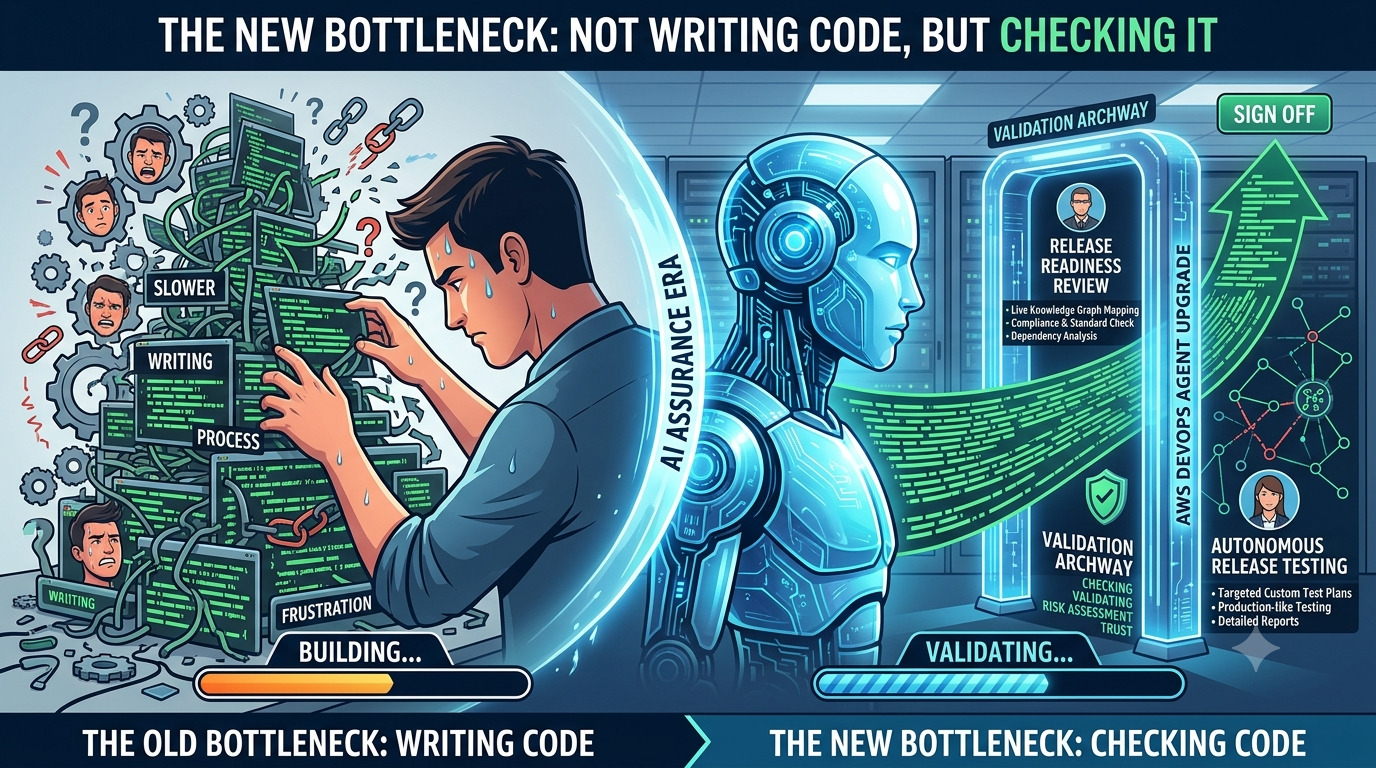
The New Bottleneck: Not Writing Code, but Checking It
For the last few years, AI coding assistants have been on a tear—they’re generating massive amounts of code faster than ever. But here’s the catch: all that code still needs a human (or a very slow process) to review it, test it, and make sure it won’t blow up in production. The bottleneck has simply shifted from writing software to validating it.
AWS just announced a major upgrade to its DevOps Agent to tackle exactly this problem. They’re adding two new AI-powered features—Release Readiness Review and Autonomous Release Testing—that act like a super-smart release engineer. Instead of waiting for code to break in production, this agent jumps in before the code is even merged, checking everything from compliance to cross-service dependencies.
What the Agent Actually Does
- Release Readiness Review (The Inspector): This feature doesn’t just run a simple “find the typo” linter. It builds a live knowledge graph of all your interconnected repositories, mapping out how different services talk to each other. When a developer submits a change, the agent evaluates it against:
- Organizational engineering standards (written in plain English, no fancy policy-code required)
- AWS Well-Architected best practices
- Potential downstream failures—like “if we change this API, will that microservice over there throw a fit?”
- Autonomous Release Testing (The Tester): Instead of blindly running the same old, slow regression test suite over and over, this agent is surgically precise. It analyzes exactly what changed and generates a custom test plan targeting that specific modification—functional tests, integration scenarios, and regression checks. It then runs these tests in a production-like environment and gives you a detailed report with logs, traces, and metrics.
Everything gets surfaced right inside your existing pull requests on GitHub or GitLab, or directly in your IDE via integrations like Kiro or Claude Code.
The Bigger Picture: The “AI Assurance” Era
AWS isn’t alone here. GitHub has Copilot Autofix for security patches, Microsoft is rolling similar things into Azure DevOps, CircleCI has “Chunk Sidecars,” and Dropbox has its Nova platform. The common thread? Everyone is realizing that helping developers write code was just the first act. The second act is helping them trust that the code actually works.
The goal isn’t to replace human approval—a human still signs off before anything goes live. But the agent does the heavy lifting, grunt work, and risk-assessment so that engineers can focus on creative problem-solving rather than hunting for needles in haystacks.
The Bottom Line
In the AI era, speed of writing is no longer your superpower; speed of safe validation is. AWS’s expanded DevOps Agent is a bet that future software pipelines will lean heavily on AI not just to build apps, but to act as a guardian that decides, “Yes, this code is ready to ship,” while the human gets the final say.
Unra
July 19, 2026Keeping the final approval with humans is a mature and reassuring stance. It acknowledges that AI can make errors, and that ultimate accountability must rest with the engineering team. It’s a partnership, not a handover.
Barsen
July 26, 2026This perfectly captures the irony of AI coding—it’s like having a chef that can prep ingredients in seconds, but you still have to cook, taste, and plate the meal. AWS is building the “kitchen staff” to handle the tasting and plating, which is where the real value lies now.
D0zef
August 15, 2026This is the quiet star of the announcement. By mapping cross-repository dependencies, the agent catches issues that no human reviewer could reasonably track in a complex microservices environment. It’s not just testing code in isolation; it’s testing the ripple effects.