
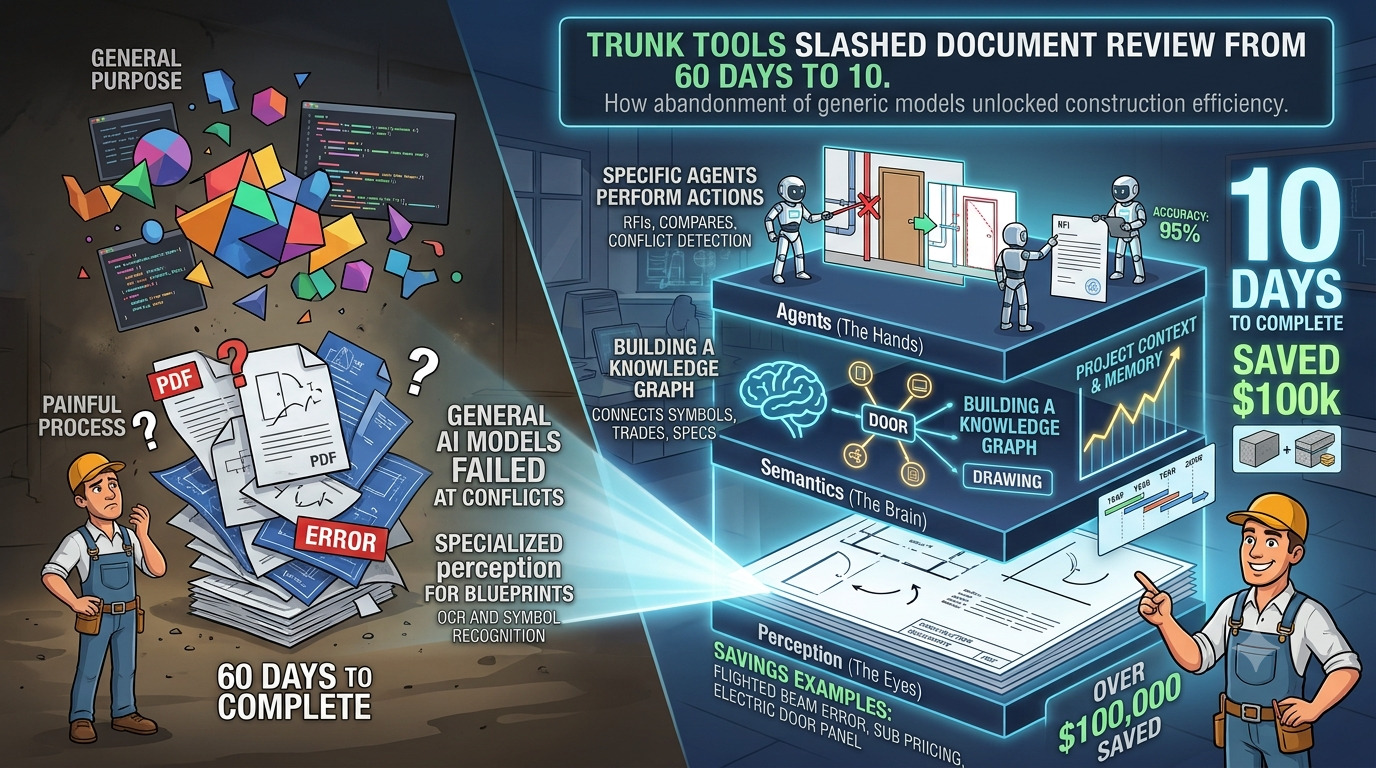
Trunk Tools slashed document review from 60 days to 10 by abandoning general-purpose models.
The Headline Result: From Two Months to a Week and a Half
A construction tech company called Trunk Tools just pulled off something impressive: they shrunk a painful 60‑day document review process down to just 10 days. How? By throwing out the rulebook on generic AI and building their own specialized, three‑layer system tailored specifically for the messy, chaotic world of construction blueprints and specs.
Why Generic AI Fails on the Job Site
Let’s be honest—most of the real world isn’t a neat, tidy spreadsheet. It’s ugly PDFs, scanned drawings, shorthand jargon, and “unspoken” rules that only a seasoned carpenter or electrician just knows.
This is where general‑purpose AI models (like ChatGPT) stumble. They’re trained to be “okay” at everything, which makes them terrible at niche, specialized tasks. They confuse abbreviations, miss tiny but critical symbols (a 2-millimeter-wide mark can mean life or death for a project), and they have zero long‑term memory—construction projects take years, not just a few paragraphs.
The Solution: A Three‑Layer Stack (Eyes, Brain, and Hands)
Trunk Tools built a custom architecture that works like a master tradesperson:
- Perception (The Eyes): This layer teaches the AI how to read construction documents. In a blueprint, a door isn’t always a picture of a door; sometimes it’s just a curved arc on a wall. The AI is trained to recognize these symbolic drawings, whether they’re on PDFs, scans, or old-school paper prints.
- Semantics (The Brain): Once the AI “sees” the door, it needs to understand what that door means. It connects that door to the specific drawing detailing it, the spec sheet governing its materials, and the trade (say, the framers) who will install it. It builds a knowledge graph of relationships.
- Agents (The Hands): Finally, smart agents sit on top to take action. They don’t just answer “is there a door here?” They answer “does this door create a conflict down the line?” They generate visual overlays comparing old and new drawings, write narratives of changes, and even draft formal questions (RFIs) to send to architects.
The “Time is Money” Payoff
Catching a mistake early is cheap. Catching it in the field when the beam is already installed? That costs tens of thousands of dollars and delays the whole schedule.
Trunk Tools shares jaw‑dropping examples:
- An agent flagged that a structural beam had been moved up by 8.5 inches without the architect documenting it. Fixing it early saved over $10,000.
- Another agent caught $60,000 in inflated pricing from a subcontractor.
- A third spotted that an electric door required a panel that wasn’t in the electrical drawings, saving roughly $100,000 in rework.
On average, the system saves workers 20 to 40 minutes per question they’d normally have to dig through binders to answer. And crucially, the company only releases agents that hit around 95% accuracy, using an “LLM-as-a-judge” system to constantly score their performance.
Smart Advice for Other Industries
The founders’ takeaway for anyone building AI in specialized fields is clear:
- Don’t try to make a model “smarter” about everything. Fine‑tune it to be reliable on the specific output format your workflow needs.
- Build modular systems so you can swap in newer, better models as they arrive.
- Play to your strengths—invest your engineering time where generic models are weak. For construction, that was perception (reading symbols) and long‑term memory.
The One Catch
Of course, there’s a trade‑off. Specialized models are brilliant at construction but pretty dumb outside of it. Also, when you use really powerful reasoning models, latency (speed) becomes a risk. Trunk Tools keeps a strict watch on this, ensuring that any slowdown is worth the massive boost in performance.
CipherGrid
July 21, 2026The biggest insight here is that “reading” messy data (Perception) is often a harder problem than “thinking” about it (Reasoning). By investing heavily in teaching the AI to recognize symbols and arcs, they unlocked value that even GPT-5 couldn’t touch. Garbage in, garbage out—regardless of model size.
Sl1
August 13, 2026This is a masterclass in ROI. The article perfectly illustrates the “1-10-100” rule of quality management—catching a mistake in the design phase costs $1, in the field costs $10, and fixing it after the fact costs $100. Trunk Tools explicitly proves this math with real dollars.