
What Is NVIDIA NemoClaw and What Role Does It Play in Agentic AI Systems?
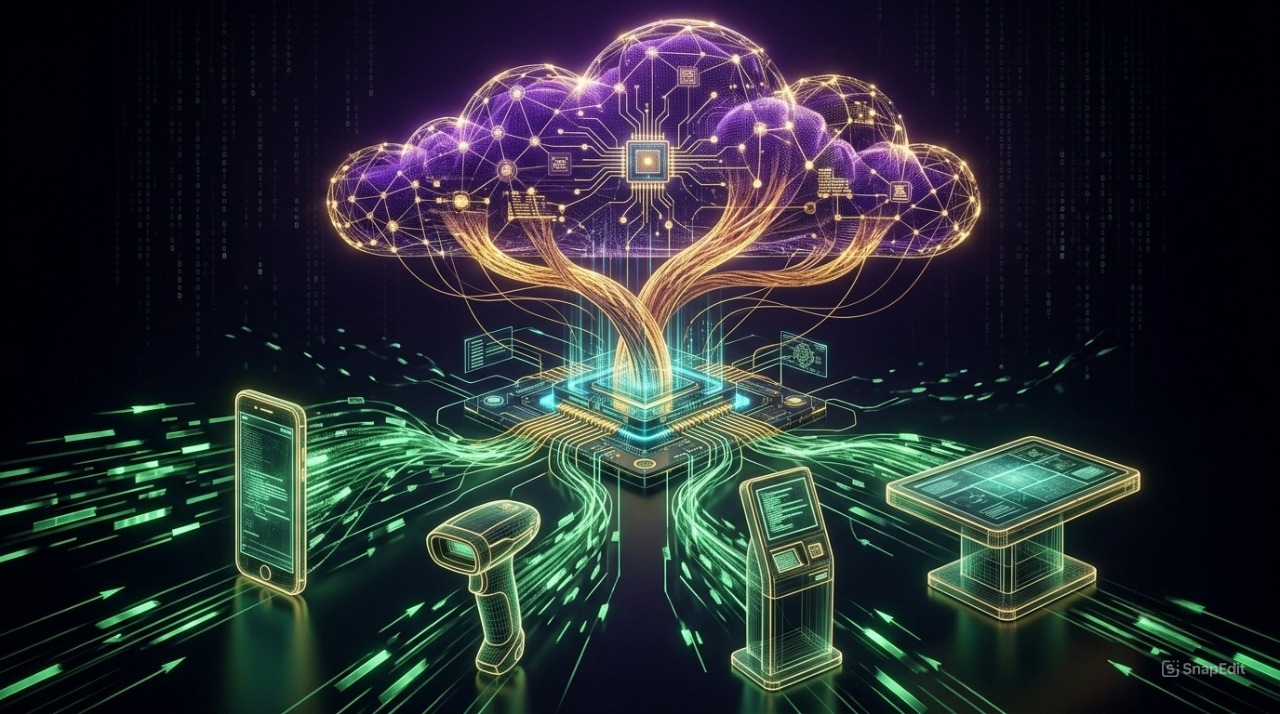
NVIDIA NemoClaw is an agent runtime and orchestration layer that coordinates AI execution across edge devices and cloud systems during live workflows.
Distributed AI architectures are necessary when applications require low-latency interaction, local context awareness, and controlled cloud usage.
NemoClaw determines where tasks run based on intent, context, and execution requirements – rather than fixed deployment boundaries.
Edge devices handle time-sensitive perception and interaction, while cloud services handle reasoning and enterprise system logic.
What Is NemoClaw?
NemoClaw is a runtime platform for agentic AI systems used in enterprise settings. It provides a structured environment for executing agents, managing their lifecycle, and coordinating how they interact with external tools, services, and data sources.
The platform governs execution flow, context handling, and decision progression as agents move through multi-step workflows.
At the platform level, the goal is reuse rather than specialization. Instead of embedding execution logic directly into each solution, organizations can apply a shared runtime that defines how agents operate, how context is preserved, and how integrations are invoked.
The platform is not bound to a single industry or deployment model. It can be applied in cloud-based systems, hybrid environments, or solutions that include device-level execution.
Where NemoClaw fits in a distributed AI architecture
In distributed AI architectures, NemoClaw functions as the runtime and coordination layer that connects execution across edge devices and cloud services.
It governs how tasks are divided based on latency sensitivity, interaction context, and workload requirements – so that execution can adapt dynamically during live workflows.
- Edge devices handle time-critical interaction: speech input, visual recognition, tracking, and lightweight intent routing
- Cloud services handle correlation across sessions, reasoning over larger data sets, recommendations, and integration with enterprise backend systems
NemoClaw coordinates these components to function as a single system rather than isolated execution paths.
Why enterprises need distributed AI orchestration now
Enterprise AI adoption is moving beyond isolated experiments toward production workflows that operate in real time and across physical environments. These workflows often involve direct user interaction, sensor input, and rapid decision-making.
In these conditions, the location of AI execution becomes a practical concern rather than an architectural preference.
Many organizations also face internal fragmentation as teams build similar agent logic, routing rules, and integrations independently. Without a shared orchestration layer, this duplication complicates governance, increases maintenance effort, and slows reuse.
Why a cloud-only AI architecture is not always enough
Cloud-based AI works well for many analytical and batch scenarios. Problems arise when workflows depend on immediate feedback and awareness of the local environment.
Voice interaction, computer vision, and physical navigation often require fast response times that suffer when every interaction must travel to a remote system.
Cost also becomes a factor at scale. High-frequency interactions routed entirely through the cloud can drive infrastructure usage that is difficult to justify for tasks that do not require centralized processing.
How NemoClaw coordinates edge and cloud workloads
NemoClaw evaluates each interaction to determine where execution should occur:
- Tasks that require immediate response or access to local context remain on the device
- Tasks that depend on broader system state or heavier computation are routed to the cloud
This coordination happens continuously during live user flows. Context, intermediate results, and execution state are passed between components so that responses remain consistent even when parts of the workflow execute in different locations.
Practical example: Store Assistant architecture
To illustrate how NemoClaw operates in practice, a reference solution called Store Assistant is used. The solution represents a hybrid assistant deployed in a retail environment where users interact through phones, kiosks, or wearables.
In this architecture:
- The edge device serves as the interaction layer – handling speech input, visual recognition, and immediate feedback
- Cloud services execute deeper reasoning and coordination with enterprise systems
- NemoClaw governs how these responsibilities are divided and connected during live interactions
Use case: Fulfillment flow support
Store employees receive tasks through a handheld or wearable device and move through the picking process. The system supports navigation through the store, identifies shelves and products, and confirms item selection.
- Low-latency functions (voice control, object recognition) run on the device to avoid delays
- When employees issue more complex requests, relevant context is sent to the cloud for reasoning and workflow logic
- NemoClaw coordinates this process so tasks progress smoothly without manual handoff
Use case: Shopper guidance
Shoppers can request product information, receive shelf guidance, generate shopping lists, or ask for recommendations.
- Local context is processed on the device to maintain responsive interaction
- Broader reasoning and personalization logic runs in the cloud
- NemoClaw coordinates these steps to keep responses timely and coherent
Business and infrastructure value
From a business perspective: This architecture improves task completion time, reduces friction in physical environments, and supports more natural interaction patterns. Employees work more efficiently, and shoppers receive guidance that reflects their immediate context.
From an infrastructure perspective: Computation remains distributed even in hybrid deployments. Central services handle orchestration, reasoning, and integration, while edge devices rely on shared cloud intelligence without duplicating heavy logic locally.
How NemoClaw is being validated
NemoClaw is currently being validated through a pilot engagement with a cloud partner. The focus is on observing system behavior under real operating conditions rather than relying on architectural assumptions.
The pilot examines:
- How workloads are divided between edge and cloud
- What latency characteristics emerge in real usage
- How the orchestration layer behaves during live execution
The goal is to assess operational value alongside technical performance, with attention to repeatability across enterprise workflows.
Why NemoClaw matters for enterprise AI platforms
As organizations build shared AI foundations across teams, the need for a common orchestration layer becomes clear. Without it, execution logic becomes fragmented and difficult to govern.
NemoClaw addresses this by providing a consistent runtime that coordinates agents, tools, and workflows across multiple domains.
- For platform and infrastructure teams – supports reuse and operational consistency
- For solution teams – provides a stable foundation for building different applications without redefining execution logic each time
Looking ahead
NemoClaw serves as a runtime platform for agentic AI systems that require structured execution, context management, and coordination across components. It provides a shared foundation that organizations can apply across different solutions without duplicating core agent logic.
While edge-cloud coordination is a meaningful use case, it represents only one way NemoClaw can be applied as part of a broader enterprise AI platform strategy.
Frequently Asked Questions
What is NemoClaw used for?
NemoClaw coordinates how AI tasks are executed across edge devices and cloud infrastructure during live workflows. It manages agent execution, routing decisions, and integration with enterprise systems.
How does NemoClaw differ from an AI agent framework?
NemoClaw does not focus on defining agent behavior alone. It governs where and how agent logic runs, how context is passed, and how tools and services are invoked across execution environments.
Why is edge and cloud coordination important for real-time AI?
Real-time workflows depend on fast response and awareness of the local environment. Keeping perception and interaction close to the user reduces delay, while cloud execution supports broader reasoning and access to enterprise data.
Can NemoClaw be reused across multiple use cases?
Yes. NemoClaw is designed as a shared orchestration component that supports different workflows, devices, and industries without redefining execution logic for each solution.
How does NemoClaw support governance at scale?
By centralizing execution rules, routing logic, and integrations, NemoClaw reduces duplication across teams and helps maintain consistent behavior, monitoring, and control as AI systems grow.
QuantumNode
June 20, 2026The key insight is that distributed AI isn’t just about performance – it’s about economics. Routing every interaction to the cloud is expensive. Running simple tasks on edge devices saves money and reduces latency.
NanoCompiler
June 23, 2026The Store Assistant example makes this concrete. Voice recognition and object detection run on the device (fast, cheap), while complex reasoning goes to the cloud (powerful, flexible). That’s the right division of labor.
VectorRuntime
June 25, 2026The governance angle is underrated. Without a shared orchestration layer, every team builds its own agent logic and routing rules – creating fragmentation that’s hard to manage. NemoClaw provides consistency across the organization.