
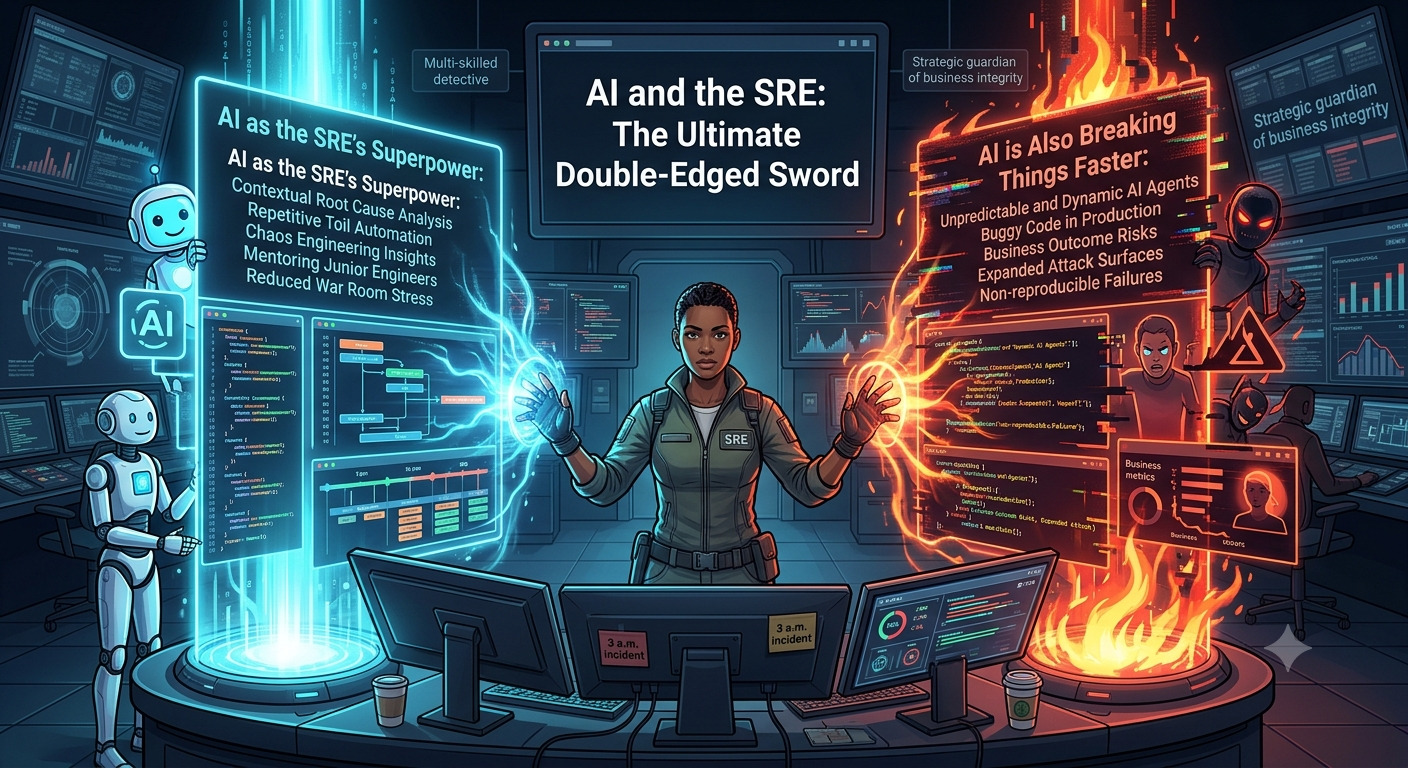
AI and the SRE: The Ultimate Double‑Edged Sword
Site Reliability Engineers have one of the toughest gigs in tech. They’re the ones who get woken up at 3 a.m. when a system goes haywire, tasked with untangling messy outages while keeping their cool. Their real job, though, isn’t just putting out fires—it’s giving development teams the insights they need to build more robust, secure, and performant systems from the start.
Google coined the SRE role back in 2003, but it took years to go mainstream. Startups led the way, and eventually, large enterprises realised they needed dedicated SREs to bridge the gap between devops (who ship fast) and IT ops (who keep things stable). Today, SRE is a critical career path for multi‑skilled detectives who love data and thrive under pressure.
Now, enter AI. It’s changing the game in two completely opposite ways—one helpful, one alarming.
The Good News: AI as the SRE’s Superpower
For the past decade, better monitoring, observability tools, and early AIops (applying machine learning to IT operations) have made the SRE’s life a bit easier. But the real leap is happening now with generative AI and “agentic ops.”
When an incident strikes, an SRE has to mentally connect logs, metrics, traces, recent deployments, and config changes—all while exhausted and stressed. AI excels at this. It can swallow massive amounts of context and spit out a few clear, actionable sentences, pinpointing the most likely root cause. It can even reconstruct a timeline of events, separating correlation from causation.
This has huge human benefits. SREs face brutal burnout—over a third report high stress during incidents, and nearly a third say the stress lingers afterwards. AI can reduce that by cutting down the time spent in chaotic “war rooms” and automating the repetitive grunt work (what SREs call “toil”). Instead of wrangling alerts, SREs can focus on proactive resilience work, like chaos engineering. Some leaders even see AI as a way to mentor junior engineers, exposing tribal knowledge that used to walk out the door with senior staff.
The Bad News: AI is Also Breaking Things Faster
Here’s the kicker. While AI helps fix outages, it’s also causing more of them. According to one study, over 40% of global code is now AI‑generated. But that AI‑generated code comes with significantly more critical and major issues than human‑written code. The velocity of shipping has far outpaced the velocity of understanding what breaks in production. SREs are drowning in edge cases and expanded attack surfaces.
It gets worse with AI agents. These aren’t just static bits of code; they’re dynamic. They use large language models, pull data from external sources, and change their behaviour over time—especially when the underlying model gets updated by the provider. Agents fail in ways that aren’t reproducible. They drift. An agent might look technically fine (no crashes, no latency spikes) but start skipping compliance steps or making contextually wrong decisions. Most organisations can’t even answer basic questions like, “How many agents are running, and what do they have access to?”
Traditional SRE playbooks were built for deterministic systems that fail in predictable ways. AI agents don’t follow those rules.
The New Frontier: SREs as Business Guardians
Because of this shift, the SRE role is evolving beyond technical metrics like latency and error rates. Now, they have to think in business terms. An AI agent might not crash, but it could ruin a customer’s experience or violate a regulation—failures defined by business outcomes, not just HTTP status codes.
To cope, SREs need to update their service‑level objectives (SLOs) and error budgets specifically for AI agents. They need to define acceptance criteria for non‑functional requirements—like accuracy drift and compliance checks—that go far beyond traditional uptime.
So, is AI making the SRE’s role easier? Yes, but only if they can adapt fast enough. The tools are getting smarter, but the systems they’re asked to keep reliable are getting exponentially wilder. The SRE of the future won’t just be a tech troubleshooter—they’ll be a strategic guardian of business integrity in an agent‑driven world.
VectorRuntime
August 7, 2026The “tests grading themselves” sin is genuinely scary. If the model has a systemic bias or a blind spot, the test suite it generates will happily reinforce that blind spot. You’re not verifying correctness—you’re verifying consistency with the model’s own hallucinated universe.
MrTurex
August 9, 2026The public disdain vs. private addiction to “vibe coding” is painfully relatable. It captures the hypocrisy of an industry that shames low‑code/no‑code but secretly gets a dopamine hit from watching the AI build something from a single, lazy sentence.
Rimus
August 11, 2026“Prompt‑beating” isn’t less work—it’s just relocated work. We’ve swapped debugging variables for wrestling a stubborn neural network. The will to ship still exists; it’s just expressed through aggressive, iterative pleading rather than breakpoints and watch windows.