
Assessing AI Readiness Through the Talent Experience
AI has moved from novelty to everyday use. The conversation has shifted from whether AI will be adopted to whether it will be used well.
Success with AI depends less on how quickly tools are introduced and more on how people experience, understand, and apply them in their work. This has brought new attention to the concept of AI readiness.
Why human readiness matters
AI readiness is often discussed in technical terms, yet adoption lives in human behavior. Employees decide whether to engage with new tools, trust their outputs, and apply them responsibly. These decisions are shaped by confidence, clarity, and feeling supported during change.
Organizations that overlook these human factors may see high levels of access but uneven use. Readiness must be assessed through the lived experience of employees, not only through system inventories or usage statistics.
The role of continuous feedback
AI readiness was approached by starting with listening. Rather than relying on a single survey or narrow metric, a steady rhythm of feedback was built to understand how associates were experiencing AI over time.
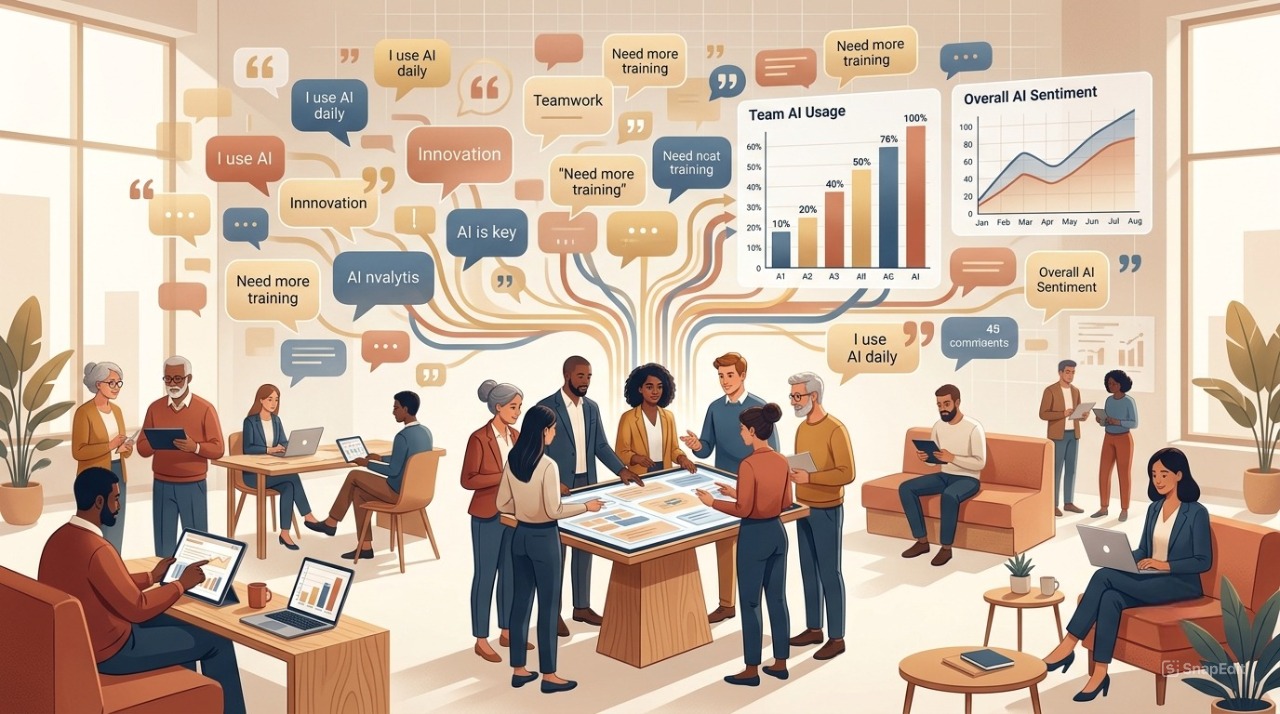
Quarterly listening cycles were combined with leadership interviews, manager experience research, learning analytics, AI fluency data, and usage dashboards across a global workforce of more than 10,000 associates.
Continuous feedback made it possible to spot changes and act on them early. It also signaled to employees that their perspectives mattered beyond initial rollout decisions.
Key insights from listening efforts
The responses revealed that employees held a range of emotions about AI. Curiosity and motivation appeared alongside uncertainty and caution.
Over 10,000 participants provided more than 45,000 comments. Collectively, those responses pointed to a shared conclusion: progress with AI depends on how people feel prepared to engage with it – not simply on whether tools are available.
Defining AI readiness: Toolset, skillset, and mindset
AI readiness was framed across three dimensions:
- Toolset – access to AI platforms, systems, and relevant data
- Skillset – practical capabilities such as prompting, verification, and understanding appropriate use cases
- Mindset – trust, confidence, and a sense of safety when trying new approaches
True readiness appears only when all three dimensions are present at the same time. Gaps in any one area reduce the likelihood of consistent use.
Metrics of AI adoption
Survey results showed that 71% of associates had access to AI tools, and 82% felt they had the resources needed to work effectively. Access was not the primary barrier.
The challenge appeared at the point where access needed to turn into confident, regular use. Readiness depended on whether employees understood why AI mattered to the organization and how it applied to their roles.
The journey of different employees
AI adoption followed different paths across the workforce:
AI Leaders – 17% of employees
These individuals tested new workflows, explored advanced use cases, and shared ideas with peers. Their enthusiasm provided momentum, though it also created a need for recognition and spaces to exchange knowledge constructively.
AI Adopters – 75% of employees
The largest group used AI in practical ways – summarizing information, drafting content, generating code, and analyzing data. This group represented the greatest opportunity for consistent value creation when given clear guidance and examples tied to daily work.
AI Explorers – 8% of employees
These associates showed interest but sought reassurance on relevance and expectations. Clear role-specific examples and supportive messaging mattered more than advanced training for this group.
AI moving into core workflows
Throughout the comments, associates described concrete ways AI supported their work. In end-year assessments, associates noted not only their use of AI but also process improvements – indicating a shift from experimentation to more integrated, value-driven application.
A clear pattern emerged: when AI aligns with practical tasks and support, teams feel more confident experimenting with AI.
The challenge of moving from access to impact
The distance between having AI tools and using them confidently showed up consistently in feedback. Employees shared concerns about accuracy, accountability, and expectations. Some hesitated because they were unsure what “good use” looked like.
This gap highlighted that readiness cannot be measured through access alone. It requires attention to how people interpret signals from leadership, peers, and organizational norms.
Setting direction and enabling momentum
Clear direction helped people orient their learning and effort. When feedback surfaced uncertainty about how AI fit into company priorities, leadership addressed it directly. That visibility grounded AI work in shared goals.
Creating conditions for trust and experimentation
Confidence grew when people felt safe acknowledging what they did not yet know. Learning was treated as ongoing, not evaluative. Communities of practice encouraged peers to learn from one another, reducing fear of making mistakes.
Supporting different roles and readiness levels
AI engagement varied by role, experience, and comfort level. Support was most effective when it reflected those differences. Practical examples tied to daily work helped some move forward, while others benefited from deeper skill development or peer connection.
Centralizing learning resources
When employees pointed out that learning resources were scattered across multiple platforms, a centralized AI Education Space was created – giving associates one place to find tools, guidance, and learning opportunities.
These actions reinforced the message that feedback led to real outcomes.
A human-centric approach
AI readiness efforts showed that adoption rests on people, not systems. Confidence grows through how change is introduced, how purpose is explained, and how tools connect to daily work.
Listening alone was not enough. Trust strengthened when feedback led to visible action and when learning unfolded in an environment where questions and uncertainty were acceptable.
The pattern remained consistent: progress followed when talent felt heard, supported, and able to develop alongside new capabilities.
Frequently Asked Questions
What is AI readiness?
AI readiness describes how prepared employees are to use AI confidently and appropriately in their daily work. It includes access to tools, practical skills, and mindset factors such as trust and comfort with experimentation.
Why is employee listening important?
AI adoption depends on individual behavior. Listening helps organizations understand how employees feel about AI, where uncertainty exists, and what support is needed.
How can organizations assess AI readiness at scale?
Through regular employee surveys, qualitative feedback, leadership input, learning data, and usage insights. Ongoing measurement allows tracking progress over time.
What limits workforce readiness?
Common barriers include unclear expectations, difficulty applying AI to specific roles, fragmented learning resources, and hesitation without adequate guidance.
Do employees adopt AI the same way?
No. Employees follow different paths – from active experimentation to practical application to early exploration. Recognizing these differences helps design relevant support.
How does leadership influence readiness?
Through clarity, consistency, and visible follow-through. When leaders address concerns, explain direction, and act on feedback, trust increases.
What role does learning play?
Learning is most effective when accessible, practical, and tied to everyday work. Centralized resources help employees move from curiosity to confident use.
Main takeaway
AI readiness assessments should extend beyond technology inventories. Understanding employee experience, maintaining continuous feedback loops, and responding visibly to what employees share are essential for sustainable adoption.
KernelShift
June 19, 2026The 75% “adopter” group is the biggest opportunity. Most employees are willing to use AI – they just need clear guidance and examples tied to their daily work, not advanced training.
CipherGrid
June 22, 2026Access is not the barrier – 71% had tools and 82% felt equipped. The real gap is confidence and clarity. That’s a leadership and communication challenge, not a technical one.
PacketWizard
June 25, 2026The three personas (Leaders, Adopters, Explorers) are a useful framework. One-size-fits-all AI training doesn’t work – different groups need different support to move forward.