
The New Google Database Playbook: Fuzzy Queries and AI in the Driver’s Seat
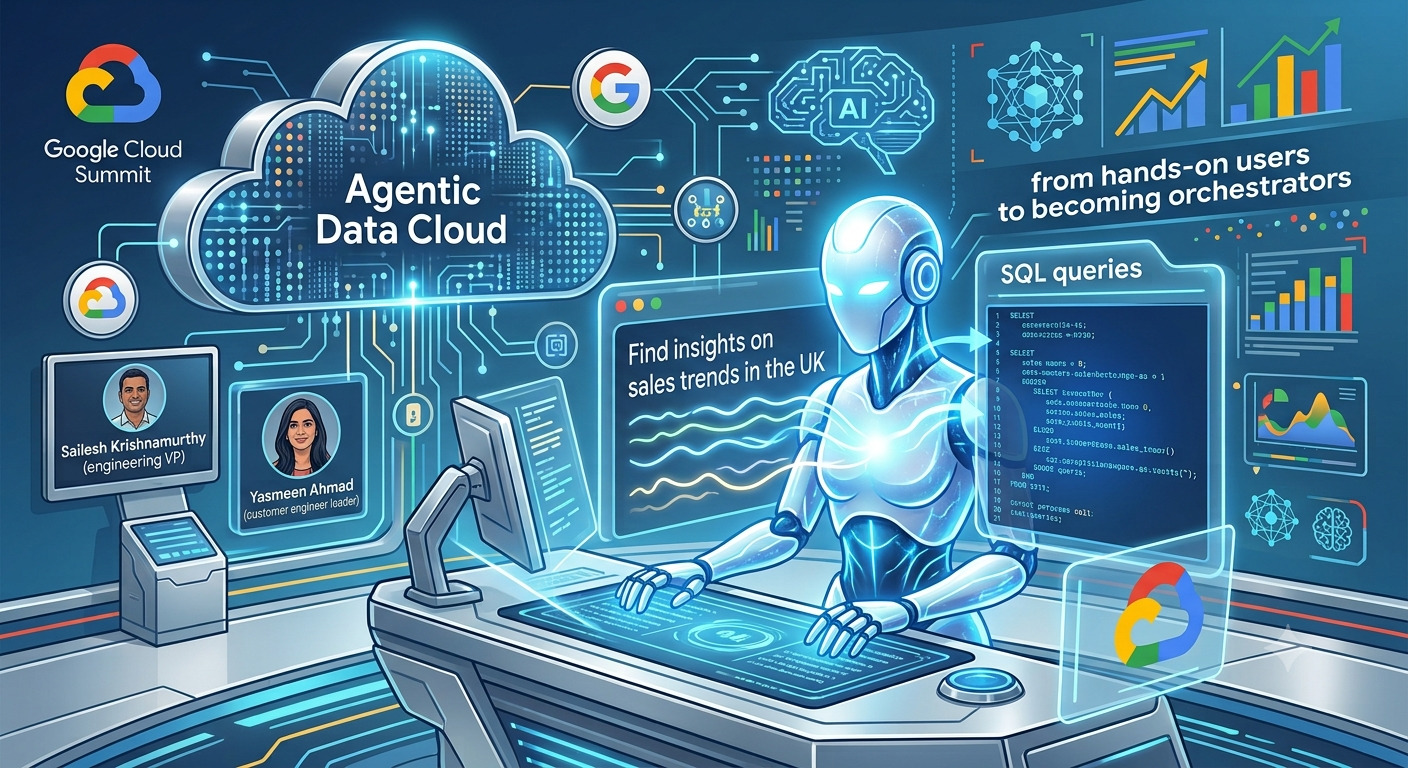
At last week’s Google Cloud Summit in London, two top database executives—Sailesh Krishnamurthy (engineering VP) and Yasmeen Ahmad (head of Agentic Data Cloud)—sat down with us to sketch out a very different future for how we’ll interact with data.
Their big prediction? In three to five years, humans won’t be clicking around data platforms anymore. Instead, we’ll tell AI “agents” what we want, and they’ll do all the heavy lifting. As Ahmad put it, we’ll go from being hands-on users to becoming orchestrators—setting goals and letting the agents figure out the grunt work.
One of the most striking shifts is about how we ask questions. Krishnamurthy explained that in this new world, getting the “exact” answer matters less than getting the “best” answer. For anyone who’s spent years mastering precise SQL queries, this sounds almost heretical. But his point is that people increasingly want to ask vague, context-aware questions—like a natural-language prompt that remembers your previous chats—rather than rigid, perfectly formatted requests.
That doesn’t mean SQL is dying. Exact questions will still get exact answers. But sometimes a fuzzy, casual question will be translated behind the scenes into a precise SQL query anyway. The real challenge is making sure that AI-generated translation is correct. How? Through “eval sets”—basically, a test bank of sample questions and their ideal answers. You keep tweaking the AI’s context until it passes all your tests.
Google is also baking AI directly into its database tools (Spanner, AlloyDB, BigQuery). For example, there’s a new function that lets you write a condition in plain English, and the database uses a large language model to decide if it’s true or false. The catch? Calling a powerful AI for every little check is slow and expensive. So Google’s clever workaround is “proxy models”—tiny, on-the-fly AI models trained right inside the database on a small slice of your data. These mini-models can handle the job using 400 times fewer tokens and cutting response times by up to 100x.
So why the rush to remove humans from the loop? Ahmad points to “intent-driven engineering.” Three years ago, AI was just a co-pilot helping you write code. Now, these models can plan and execute multiple steps in parallel. You define an outcome—“increase sales in this region”—and the model maps out the steps to get there. Dashboards, she argues, will fade away because they only answer predictable questions. Instead, business users will just have conversational chats with their data.
Of course, it’s not all smooth sailing. Even 90% accuracy—which Ahmad says some customers now achieve—isn’t good enough if an AI error blocks your credit card transaction or rejects an important application. Also, every AI call costs money (tokens), on top of storage and compute bills. While better productivity might offset that, it’s not guaranteed. Still, Google is thrilled: the AI boom is massively boosting their storage and query volumes. Spanner now handles 7.5 billion queries per second (up from 5 billion a year ago) and holds 23 exabytes of data. Models tend to fire off multiple queries per user request, so the growth keeps accelerating.
Ruichi
August 5, 2026Trust is the elephant in the room. Moving from “provably correct” to “probably good enough” is a huge cultural shift. For internal analytics, that might fly—but for finance, healthcare, or billing, even a 5% error rate is a non-starter. Google’s eval sets are a start, but they don’t guarantee safety in real-time, edge cases.
NullVector
August 9, 2026The proxy-model idea is quietly brilliant. Instead of hitting a massive LLM for every trivial lookup, training a tiny local model on the fly is a smart cost-saving hack. It shows that the real AI battleground isn’t just model quality—it’s efficiency and economics.