
Stop Obsessing Over AI Models. Focus on the Operating System Around Them.
Most business leaders are still asking the wrong question. They want to know: Which model is the smartest? Which coding agent is fastest? Who just topped the leaderboard?
It’s understandable. It’s also increasingly irrelevant.
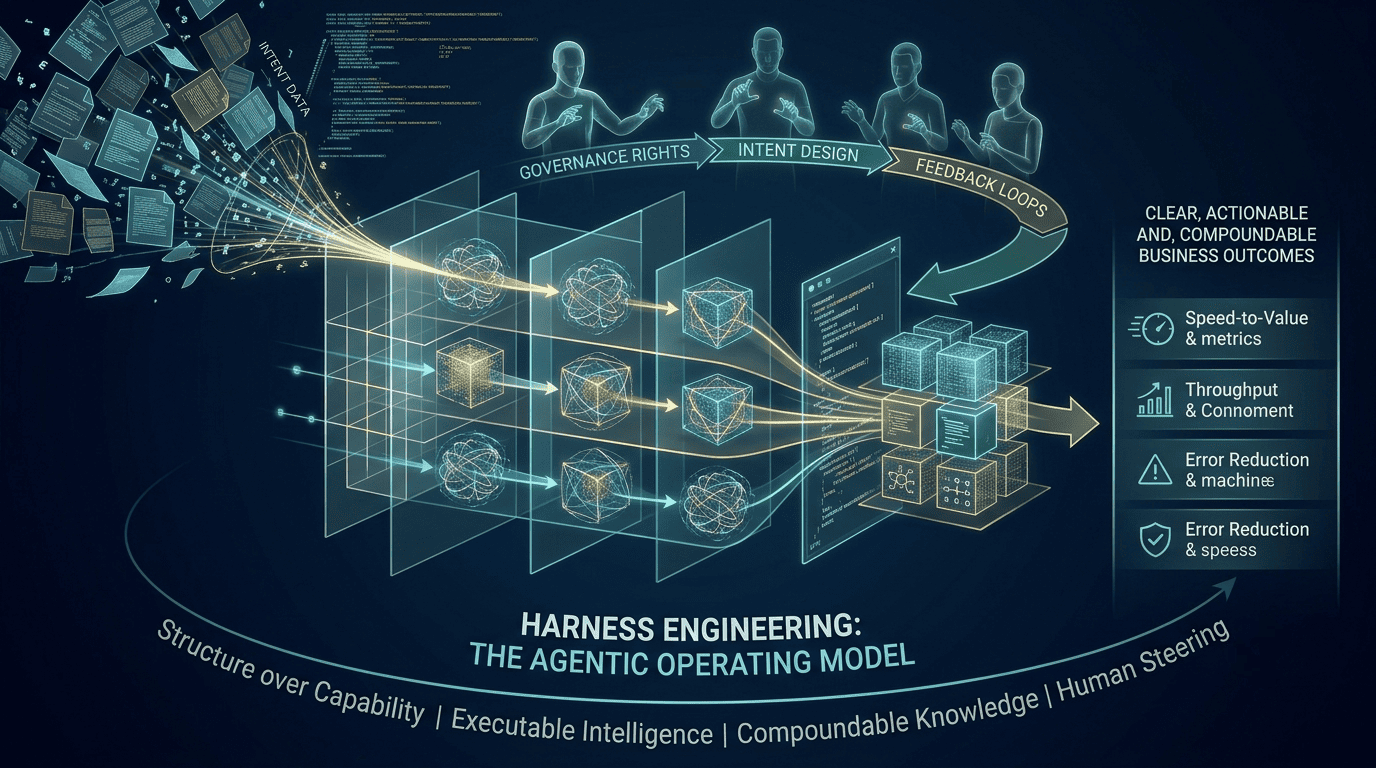
The real breakthrough happening right now isn’t about raw AI intelligence. It’s about harness engineering—the infrastructure, workflows, controls, and human oversight that turn a smart AI into a reliable worker.
Think of it like this: You can have a Formula 1 race car (the AI model), but if you put it on a dirt road with no rules and a drunk pit crew (the operating environment), it’s going to crash. OpenAI admits this directly: their internal Codex project wasn’t held back by the model, but by the missing tools, feedback loops, and structure around it.
At Star, we’re seeing this play out in real-time. By building the right “harness,” we’re seeing 2x to 3x improvements in delivery speed. A task that used to take a full “two-pizza team” (about 6-8 people) can now be handled by a “one-pizza team” (3-4 people) working alongside AI agents. The secret isn’t that the AI writes faster code; it’s that the right harness lets smaller teams move with laser precision and less operational drag.
Here are the 5 hard-won business lessons leaders need to steal from this shift.
1. Build the Infrastructure First, Ignore the Model Hype
The smartest AI in the world will fail in a bad environment.
Look at Vercel. They found that giving their internal agent access to fewer tools actually made it better. By removing 80% of the agent’s tools, they saw success rates jump from 80% to 100%, execution speed up 3.5x, and token usage drop 37%.
For leaders: This is why your AI pilots look great in a demo but break in production. The model isn’t the problem—the messy, underspecified environment around it is. Stop asking “How good is this model?” and start asking “What structure do we need to build around it to make it safe and effective?”
2. Move Your Humans Upstairs (To the Control Tower)
The new rule: Humans steer, agents execute.
Engineers are moving away from writing every line of code and towards designing the environment, setting the intent, and building feedback loops. This isn’t just for coders—it applies company-wide. Humans need to sit “above the loop” to direct outcomes, and only step “inside the loop” when personal judgment or empathy is required.
Here’s the brutal stat: 84% of companies haven’t redesigned jobs to fit AI (Deloitte). They are just slapping AI onto old workflows. If humans are still doing the same approvals, exceptions, and rework, you haven’t built an AI company—you’ve just added an expensive autocomplete.
3. Your Company’s Knowledge Must Be “Machine-Readable”
A data strategy isn’t enough anymore. You need a knowledge strategy.
If your institutional wisdom is locked in slide decks, email threads, or (worst of all) in the heads of your senior staff, your AI agents are blind. They can’t use what they can’t see.
In agentic systems, a single, massive reference document fails. It overwhelms the AI’s context, gets outdated, and can’t be validated. The winning pattern is a structured knowledge system that loads relevant info progressively, scoped precisely to the task.
Hard truth: If an AI agent can’t access your knowledge effectively, that knowledge might as well not exist for your business operations.
4. Central Rules, Local Freedom (The Federated Model)
You can’t control everything centrally, and you can’t trust everything locally. So how do you balance it?
The answer is a federated model: Enforce the hard boundaries centrally, but let execution be flexible locally. (Just like Stripe’s “Minions” system, which locks down critical steps but lets AI handle the creative, ambiguous subtasks).
For leaders, this means central teams should provide the shared platforms, compliance controls, and security guardrails. But individual business domains should own the day-to-day governance of their AI workflows. Give local teams the freedom to solve problems, but enforce the “Golden Rules” (like security and compliance) mechanically.
5. Engineer the “Fix” Into the System
If a human makes a mistake, it affects one thing. If an AI agent learns a bad habit, it spreads like wildfire across hundreds of workflows instantly.
AI doesn’t just accelerate output; it accelerates pattern replication—both good and bad. By the time a manager spots a systemic error, it might already be embedded in dozens of decisions.
This means you can’t rely on manual cleanup. You have to build correction into the machine. When an agent fails, the system needs to trigger structured diagnosis and update its own rules automatically. OpenAI calls this “continuous garbage collection”—background tasks that constantly scan for deviations and fix them before they become a crisis.
The Final Takeaway: Design Talent and Tech Together
Here is the biggest mistake leaders make: upgrading their tech stack on one side and retraining their people on the other, without connecting the two.
The shape of work is changing. Agents will handle the tireless, scalable execution. Humans will handle the ambiguity, stakeholder negotiation, and genuine emotional intelligence.
These two tracks—infrastructure and talent—must be designed in the same conversation. When they are aligned, every AI investment compounds. When they aren’t, you’re just putting a high-performance engine into a car with square wheels.
D0zef
July 12, 2026The point about “knowledge being machine-legible” is a silent career killer waiting to happen. Middle managers whose value was holding “tribal knowledge” in their heads are about to become obsolete. The future belongs to those who codify, document, and structure information for systems to use.
SeFFkA
July 16, 2026“Engineer correction into the system” is the scariest part for traditional risk management. If your AI picks up a bad practice, it scales it instantly. You can’t rely on quarterly audits anymore; you need real-time, automated governance. This is essentially moving from “Security as a checkpoint” to “Security as a real-time operating system.”
Unra
July 24, 2026The Vercel stat (removing 80% of tools led to 100% success) is the most counter-intuitive business lesson here. We’re so conditioned to think “more options = better results.” In AI, constraint is actually liberation. Less clutter means the agent spends less time guessing and more time executing.