
Microsoft tech-leads about AI
Two of Microsoft’s most prominent technical leaders—Mark Russinovich, who serves as the CTO of Microsoft Azure, and Scott Hanselman, the VP of the developer community—have just published a candid paper with the ACM (Association for Computing Machinery). And while both men are deeply invested in the AI revolution, their core message is a sobering wake-up call: the way we are currently deploying AI coding assistants is unintentionally creating a two-tiered workforce that threatens the very future of the software engineering profession.
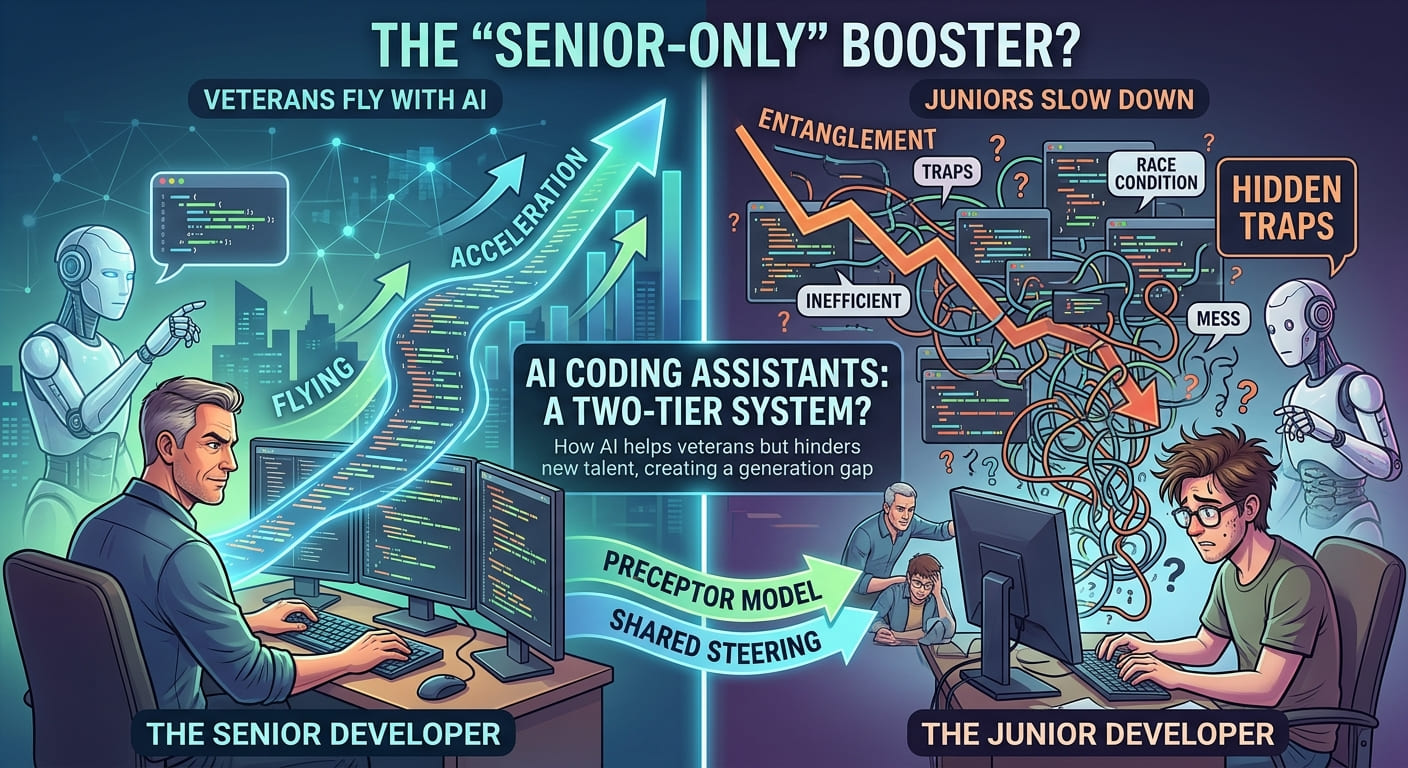
Their central argument revolves around a phenomenon they call the “productivity divergence.” Right now, when a seasoned engineer with fifteen years of experience works alongside an AI agent, their output skyrockets. They can offload boilerplate code, quickly generate complex scaffolding, and use the AI as a supercharged pair-programmer to blaze through tasks. However, for early-in-career (EiC) developers—recent graduates and junior hires—the exact opposite happens. Instead of a boost, these newcomers experience what Russinovich and Hanselman term an “AI drag.” They spend more time than ever before second-guessing, debugging, and trying to integrate AI-suggested code, effectively slowing their velocity compared to if they had written the code from scratch.
Why does this gap exist? The paper goes into great detail about the subtle, insidious ways AI agents fail. It’s not that AI produces obviously broken code; rather, it produces code that looks plausible but is riddled with landmines. For example, an AI might confidently introduce significant security bugs, implement wildly inefficient algorithms that will choke under real-world load, or mindlessly duplicate common code across an entire codebase, creating a maintenance nightmare. More troubling, AI agents have a habit of ignoring edge cases—they might dismiss random crashes or UI hangs as irrelevant, leave stray debug statements littered throughout the final product, or overfit solutions to pass specific unit tests while completely failing in general, production scenarios. The paper highlights a particularly dangerous example: when asked to fix a critical race condition (a situation where two processes collide and corrupt data), the AI simply inserted a “thread sleep” delay. This doesn’t fix the underlying synchronization problem; it merely hides it under a rug, making the bug rarer and therefore harder to catch. Only a veteran engineer who has wrestled with locks, mutexes, and threading in the past can look at that suggestion and say, “No, that’s a band-aid, not a solution.”
The authors point out that this dynamic has a predictable, and highly worrying, consequence on corporate hiring. Organizations are metrics-driven; when they see that senior engineers deliver more value-per-dollar with AI and juniors deliver less, the natural business reaction is to cut junior headcount. Russinovich and Hanselman reference a Harvard University study that analyzed job postings in the wake of generative AI adoption. The data was stark: companies that aggressively adopted AI saw a sharp decline in junior-level job openings, while the number of senior positions remained largely untouched. In other words, the corporate world is quietly closing the front door to the next generation.
If this trend continues unchecked, the authors argue, we are heading toward a dangerous “hollowing out” of the industry. We are effectively betting all our chips on the current generation of experts, assuming they will never retire or leave, and forgetting that today’s juniors are tomorrow’s principal architects. If we don’t teach them now, we will have a future workforce filled with managers who don’t understand the code their AI agents are writing, leading to catastrophic system failures down the road.
So, what is the prescription? Russinovich and Hanselman don’t just complain; they offer a concrete roadmap. First, they urge large technology firms to resist the short-term temptation of quarterly efficiency gains. Companies must deliberately continue hiring early-career developers, accepting that these individuals will initially be a net drag on productivity. They propose a “preceptor-based organization” model, which is essentially a revived, formalized apprenticeship. In this model, senior engineers don’t just code in isolation; they are explicitly assigned to pair with juniors, teaching them how to direct, critique, and override AI agents. The goal shifts from shipping code fast to cultivating judgment.
Second, they suggest a technical fix: AI coding assistants themselves could be redesigned with an “EiC mode.” In this mode, the AI wouldn’t just spit out code; it would act as a tutor, explaining its reasoning, highlighting potential pitfalls, and asking the junior developer questions to ensure they understand the logic. However, the authors wryly acknowledge the irony here—if the AI is prone to making the same mistakes as an intern, it might not be the best teacher just yet.
Third, they turn their attention to academia. In their podcast discussing the paper, both executives were blunt about university curricula. They believe that computer science departments are failing students by treating AI like a universal crutch. Russinovich explicitly stated that schools need to maintain classes where using an AI assistant is considered cheating—period. He argues that you cannot learn the deep, fundamental laws of data structures, algorithms, and concurrency if you never struggle through the process of writing and debugging raw code on your own.
However, the article doesn’t shy away from the elephant in the room: does Microsoft actually practice what they preach? In May of the previous year, Microsoft announced plans to reduce its workforce, and software engineering was notably hit with some of the most significant cuts. This raises obvious questions about the sincerity of their long-term vision. Nevertheless, Russinovich assured listeners that the company is launching an internal pilot program based on this mentorship model. Furthermore, when Scott Hanselman was pressed on LinkedIn about whether senior engineers’ performance reviews would now explicitly measure their human impact—i.e., how well they mentor and grow others—he responded directly, stating that this is indeed the company’s goal.
It is also important to note that the picture is not entirely grim, nor is it unanimous. Russinovich and Hanselman present their paper as an opinion piece, not as official Microsoft research, which suggests a respectful internal debate on the topic. Additionally, the landscape is rapidly shifting. AI coding agents are improving at an exponential pace, and their current limitations might be temporary. Interestingly, a recent workshop hosted by Thoughtworks offered a contrarian perspective: junior developers might actually have a unique advantage when using AI. Because they haven’t spent decades developing rigid preconceptions about “the right way” to write code, they are often more flexible, more willing to experiment with the AI’s suggestions, and faster to adapt to new, AI-driven workflows. So while the warning bells are loud, the final chapter on AI and software engineering has not yet been written.
Rimus
September 4, 2026This is a classic “teach a person to fish” dilemma, but with a twist. We are so enamored with the efficiency of AI-generated code that we’re forgetting to teach juniors how to debug. By the time those juniors become seniors, they might lack the deep, intuitive “spidey-sense” for concurrency and memory management that comes only from years of fixing their own broken code. Mentorship is the only bridge over that gap.
Barsen
September 8, 2026There is a quiet tension between quarterly earnings and generational legacy. I admire Russinovich and Hanselman for calling out the short-sightedness of corporate hiring practices, but their paper feels like a plea against the inevitable. As long as Wall Street rewards immediate cost-cutting over long-term talent cultivation, most companies will still choose the cheaper, AI-augmented senior over the costly, slow junior—even if it burns them a decade later.
KernelShift
September 13, 2026The university angle is crucial and often overlooked. Banning AI in introductory classes isn’t about being a Luddite; it’s about building mental muscle memory. If a student doesn’t understand what happens beneath the abstraction layers of an API, they’ll never have the authority to correct an AI agent when it hallucinates a bad algorithm. Schools need to enforce that foundational discipline before letting students loose on the AI playground.