
Building Custom MCP Infrastructure for QA: Why a TestRail Integration Was the Right Place to Start
AI-assisted engineering workflows have made one thing clear: model capability is only part of the solution. The real impact happens when AI operates within the systems where work actually gets done.
While a large language model (LLM) can summarize requirements, suggest test coverage, or generate automation logic, it often can’t work effectively across the various tools where a team’s knowledge lives. Product requirements, test cases, checklists, traceability data, and automation assets are typically spread across separate systems. The intelligence exists, but workflows remain fragmented.
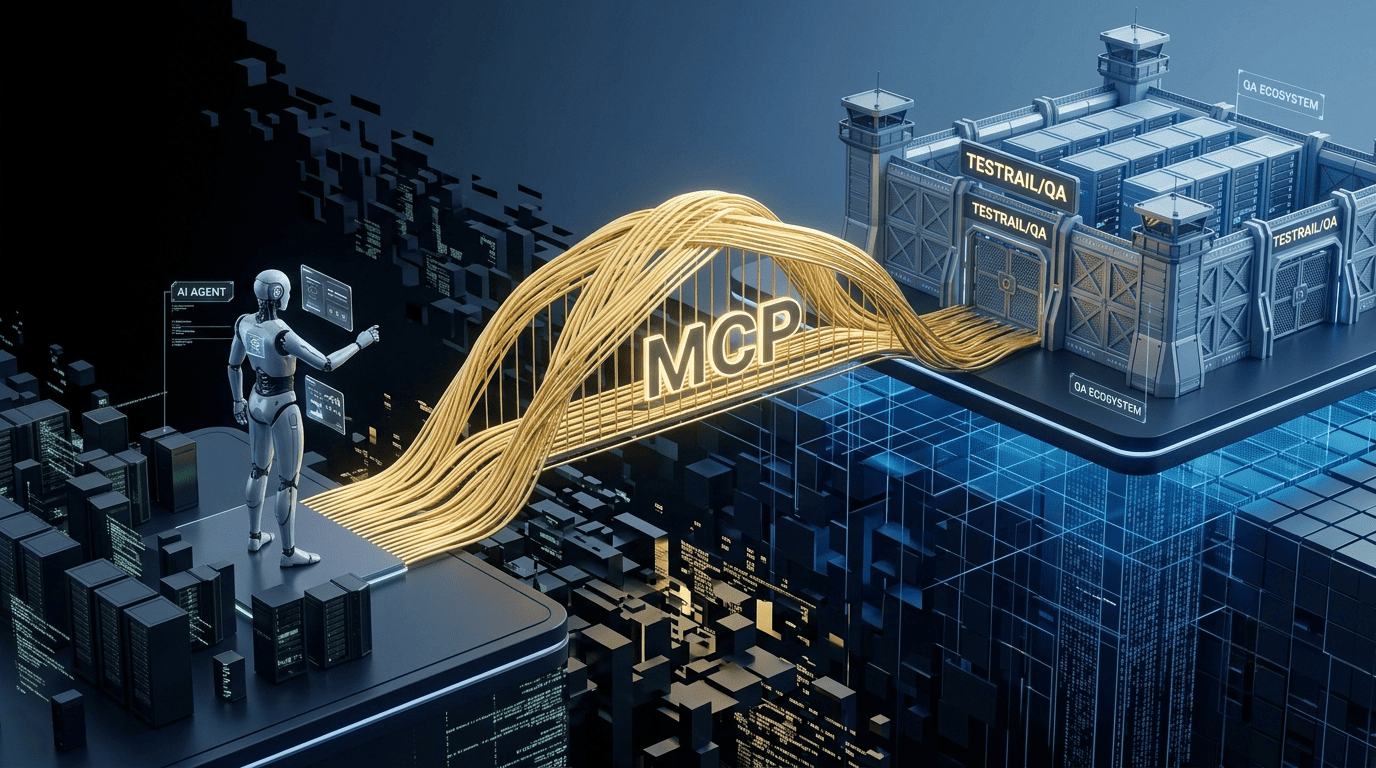
That’s exactly where the Model Context Protocol (MCP) becomes valuable. MCP creates a bridge between AI agents and external systems, allowing natural language requests to trigger operations on APIs, databases, filesystems, and other services. While the concept is straightforward, most teams still lack this bridge for their critical delivery tools.
TestRail was one of those gaps.
The problem was workflow friction, not model capability
The decision to build a custom MCP server for TestRail began as a practical response to workflow friction: too much time spent manually maintaining test documentation, too much context trapped in separate systems, and too little connectivity between AI agents and the QA environment.
The hypothesis was that the MCP server would reduce time spent on documentation. It went beyond this, becoming a strong example of how custom MCP infrastructure can turn isolated AI assistance into something operational.
Why no existing solution was suitable:
- No official TestRail MCP server existed
- Most alternatives were closed-source and raised security concerns
- Open-source options felt like MVPs rather than production-ready tools
The real bottleneck: moving context between systems
A lot of discussion around AI in QA focuses on generation: test ideas, cases, automation, and summaries. But in day-to-day delivery, the larger constraint is often not generation itself. It’s the effort required to move context between systems, keep documentation synchronized, and make sure the right information reaches the right place.
That was the pain point behind this TestRail integration. QA engineers were already using AI to support documentation work, but the process still depended on manually pulling information from one system, reworking it in another, and then updating TestRail by hand. Product requirements changed. Test documentation needed to change with them. The work was necessary, but repetitive and time-consuming.
The value didn’t come from asking AI to replace QA judgment. It came from removing the mechanical work around that judgment. Engineers still review, validate, and co-create the documentation. What changed was the burden of manually executing the update process inside the tool.
TestRail was a strong MCP candidate
Not every engineering tool is equally suited for MCP integration. The best starting points share a few characteristics:
- They contain high-value information
- That information is structurally important to delivery
- Much of it is text-based
- The system already offers stable public APIs
TestRail matched these conditions well. Its data is highly relevant to both humans and AI agents. Test cases, coverage information, test steps, and related documentation are all expressed in language, which makes them a strong fit for LLM workflows. Just as importantly, TestRail already exposes mature public APIs.
Simple in principle, valuable in practice
At a high level, the architecture is simple: an AI client, an MCP server, and a TestRail instance.
The client is the interface where a user interacts with the AI. The MCP server sits in the middle and contains the logic for authentication, tool execution, and API interaction. The TestRail instance remains the system of record.
A user writes a natural language request, the AI identifies the relevant tool, the MCP server translates that request into the appropriate API call, and the result returns to the user in a conversational form.
The practical value is much larger than the abstraction layer suggests. Instead of learning the structure of the TestRail UI, navigating manually, and performing repetitive updates field by field, teams can retrieve, inspect, and modify testing assets through the same conversational interface they’re already using elsewhere.
Start with the basics: CRUD over complexity
One of the more telling parts of this implementation is that the most valuable API capabilities were not unusual or experimental. They were the fundamentals of test case management: retrieve information, update existing cases, create new ones, and remove obsolete artifacts.
That reframes the starting point: the most useful AI integrations are often not the most ambitious ones. They connect a high-frequency workflow to a dependable set of operations. Here, the core value came from enabling AI to work across the basic CRUD lifecycle of test documentation – because that’s where so much of the daily maintenance burden sits.
The move from MVP to deployed service changed the nature of the problem
The original implementation was built locally, for one user, to validate whether the workflow improvement was real. That’s a sensible pattern – it keeps scope manageable, proves value quickly, and avoids overengineering.
But what works as a local tool doesn’t automatically work as a shared service.
Once the MCP server was deployed and adoption expanded, the architectural requirements changed:
- User management became necessary
- Authentication needed to be more robust than a single set of credentials
- Integration expectations widened
- The system had to support usage patterns beyond one person’s environment
The difficult transition was not from “no AI” to “AI.” It was from “single-user helper” to “multi-user operational service.”
Interoperability turned out to be harder than the basic implementation
One of the more revealing lessons came when other people started using the MCP server in different environments.
There’s a common misconception around early MCP adoption: that once a server conforms to the protocol, clients will behave consistently. In reality, different MCP clients may support the protocol differently or impose their own integration constraints. A local implementation that works well in one setup may require additional refinement before it behaves reliably across a broader set of tools and user types.
This points to a more mature way of thinking about MCP. The server is not the whole product. The usable product is the combination of server behavior, client compatibility, deployment model, authentication design, and ease of setup.
For multi-user support, questions of credentials, ownership, traceability, and access control become far more important. Users should operate through their own credentials rather than a shared account – a security and accountability decision. In collaborative QA workflows, knowing who made a change, when, and why matters.
The strongest proof of value was speed, but the broader effect was organizational
For daily test documentation work, the MCP server effectively doubled QA engineers’ speed. But the broader effect may be even more important.
Once access to TestRail data became conversational and low-friction, people outside QA began using it too. Product roles and managers engaged with testing information more directly. Developers could use test cases more easily when diagnosing regressions. TestRail stopped being a specialist interface and became a more accessible source of product knowledge.
This is a meaningful shift. A well-designed abstraction layer doesn’t just make an expert faster. It broadens participation. It allows more of the organization to engage with the underlying system without needing to master the system itself.
Test documentation becomes the most reliable source of truth
One of the most interesting use cases is not about editing test cases at all – it’s about retrieval.
In large projects, formal requirements are not always the easiest or most reliable place to understand how a feature currently behaves. Requirements may be scattered, outdated, or difficult to locate. Test cases, by contrast, are often kept closer to reality because they’re exercised repeatedly through manual checks and automated runs.
That makes the MCP integration more strategically useful than a narrow QA tool. It turns TestRail into a queryable knowledge layer for the wider team. An AI agent can retrieve current behavior, summarize likely coverage, identify gaps, and help teams reason about the product using the testing artifacts already being maintained.
The right starting point is a narrow operational problem, not a platform vision
There’s a useful discipline in how this was built. It didn’t begin with an attempt to create a universal QA intelligence layer. It began with a straightforward decision: solve one painful workflow first.
Start with a small MVP. Choose one clear operational problem. Put the server into real use. Let actual usage reveal what needs to come next.
In this case, the solution started local, proved itself, expanded across departments, and is now being considered as part of broader internal AI infrastructure.
What this points to next
The long-term implication is not limited to TestRail. The same pattern can be applied anywhere a company relies on structured, high-value information stored in third-party systems with usable APIs.
Many businesses already have the data they need. What they lack is a practical conversational bridge between AI and the systems where that data lives. MCP can provide that bridge.
As usage expands, these integrations shift from optional infrastructure to operationally significant tools. The value is not in connecting AI to a system – it’s in making that connection dependable enough to support daily work.
CodeNexus
June 19, 2026The most valuable insight here is that the real bottleneck wasn’t generating test cases – it was moving context between systems. That’s where AI integration actually delivers operational value.
BinaryPilot
June 21, 2026The MVP-to-production transition is underappreciated. A local tool that works for one person becomes a completely different problem when shared across teams – authentication, user management, and client compatibility all change.
[email protected]
June 22, 2026The fact that product managers and non-QA roles started using TestRail after the MCP integration is a powerful signal. A good abstraction layer doesn’t just make experts faster – it makes knowledge accessible to the whole organization.