
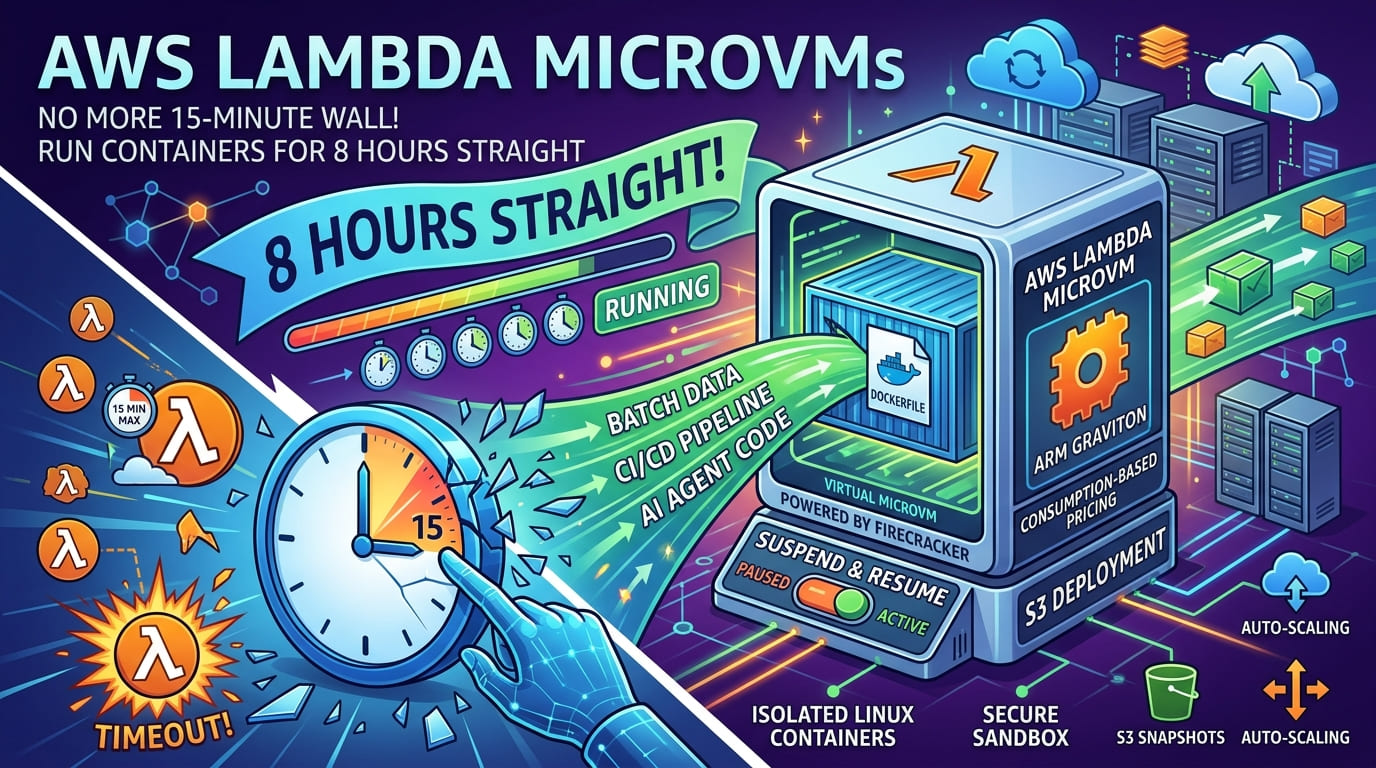
AWS Lambda MicroVMs: Now You Can Run Containers for 8 Hours Straight
Key Takeaways
- AWS has supercharged Lambda with MicroVMs—isolated Linux containers that can run for up to eight hours, obliterating the old 15‑minute ceiling.
- Built on Firecracker, these MicroVMs turn your Dockerfile and app artifacts (uploaded to S3) into bootable snapshots that can scale to multiple instances on demand.
- The headline use case is security: scanning dodgy packages, checking for vulnerabilities, or executing AI‑generated code without risking your core infrastructure.
- But developers are already dreaming bigger—full shell access, flexible HTTP ingress, and consumption‑based pricing make this a Swiss Army knife for long‑running tasks, CI/CD pipelines, and even AI agents.
- A killer feature: MicroVMs can suspend when idle, pause compute charges, and resume exactly where they left off—perfect for workloads that come and go.
The 15‑Minute Wall Is Gone
For years, AWS Lambda had a hard stop at 15 minutes per invocation. That worked fine for quick triggers and micro‑services, but anything that needed a bit more time—think data processing, batch jobs, or interactive coding sessions—was out of luck.
Enter Lambda MicroVMs. Built on Firecracker (AWS’s own lightweight virtual machine monitor), these isolated environments let you run Linux containers for up to eight hours. That’s a 32‑fold jump, and it opens up a whole new world of possibilities.
The workflow is refreshingly straightforward: you define a container with a Dockerfile, bundle your application artifacts, upload everything to Amazon S3, and Lambda does the rest—turning it into a Firecracker snapshot that can spin up multiple instances as traffic demands.
More Than Just a Sandbox
AWS pitches MicroVMs primarily as secure execution environments. Need to inspect a suspicious package? Scan a third‑party library for known vulnerabilities? Run that AI‑generated Python snippet without giving it the keys to your kingdom? MicroVMs give you an isolated sandbox where even malicious code can’t escape.
But developers are already looking past the “security island” narrative. One early user summed it up nicely:
“You can run anything you like for up to 8 hours, with full shell access and unopinionated HTTP ingress, while still getting SnapStart and true consumption‑based pricing. It’s a complement to functions.”
That last bit is crucial—MicroVMs aren’t replacing Lambda functions; they’re a new tool in the toolbox for workloads that need more time, more control, or both.
AI Agents and Beyond
AI agents are an obvious fit. You might have an LLM that needs to spawn a temporary environment to run generated code, test a script, or interact with external tools. AWS already has an AgentCore Runtime for similar purposes, but MicroVMs are more flexible:
- They can be suspended and resumed (AgentCore can’t).
- They support full shell access.
- They can handle generic workloads, not just AI.
In fact, AWS provides a skill for its Agent Toolkit that uses MicroVMs, making it a simpler on‑ramp than the dedicated AgentCore Runtime. There’s even a guide for using MicroVMs with Anthropic’s Claude, showing that this isn’t just theoretical—it’s production‑ready today.
Smart Scaling and Suspension
One of the cleverest parts of the design is how MicroVMs handle lifecycle. A MicroVM can be running, suspended, or terminated. When traffic dies down, it automatically suspends itself; when a new network request arrives, it springs back to life with its entire state preserved—no cold‑start penalties, no lost in‑progress work.
It can also auto‑scale up to four times its base specification, so if your task suddenly gets heavier, the VM grows to meet it (within those four limits, of course).
Pricing That Rewards Idleness
Billing is refreshingly honest:
- You pay per second for vCPU and RAM (provisioned in a fixed 2:1 GB‑to‑vCPU ratio).
- You also pay for snapshot storage and data transfer.
- When the VM is suspended, compute charges stop cold.
That means you can keep a long‑running environment “alive” for a full workday, but if it’s mostly idle, you’re only paying for storage snapshots—not for wasted compute. It’s a clever trade‑off that makes longer runtimes economically viable.
Current Limitations
For now, MicroVMs are only available in US East, US West, Tokyo, and Ireland regions. And they’re exclusively Arm‑based Graviton instances—no x86 yet.
Also, remember that an isolated VM is only one piece of the security puzzle. If your code needs to call out to other AWS services or the internet, you’ll still need to manage network permissions carefully. The sandbox protects you from the code, but it doesn’t protect other resources from the sandbox if you give it broad network access.
What This Means for Developers
The 15‑minute limit was one of Lambda’s most enduring pain points. MicroVMs finally erase that line, giving you a serverless, ephemeral environment that’s suitable for everything from security auditing to a full day’s worth of batch processing.
Best of all, because auto‑suspension stops the meter, you get the benefits of long‑running containers without the fear of an astronomical bill. It’s a thoughtful, practical evolution of serverless—and one that developers have been quietly asking for, for a very long time.
Rimus
July 25, 2026I’m curious about the network security implications. Yes, the VM is isolated, but if your AI agent needs to access internal APIs or an S3 bucket, you’ve just opened a potential attack vector. AWS needs to provide clearer guardrails for safely connecting MicroVMs to sensitive resources without undermining the very isolation they’re selling.
NullVector
July 28, 2026Suspension/resume is the unsung hero here. Paying only for snapshot storage during idle periods is a clever economic hack. It means you can keep a development environment or an AI agent “parked” between requests, avoiding both cold starts and runaway costs—best of both worlds.
Ruichi
August 16, 2026The 8‑hour runtime is a game‑changer for CI/CD and data pipelines. Finally, developers can run long integration test suites or heavy data transformations without hacking together weird workarounds or migrating off Lambda. It removes a major artificial constraint and makes serverless genuinely viable for more than just quick triggers.