
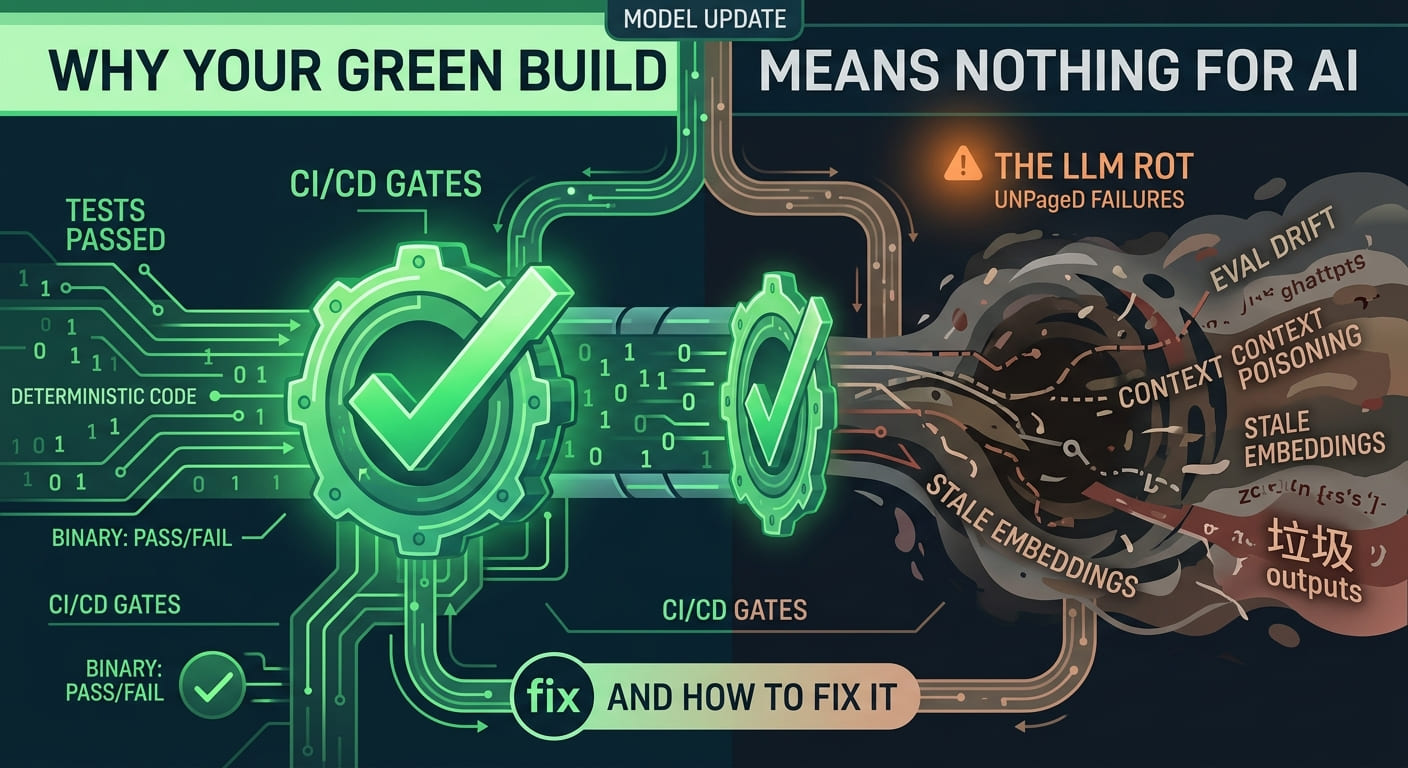
Why Your Green Build Means Nothing for AI (And How to Fix It)
Key Takeaways
- Traditional CI/CD gates are binary—tests either pass or fail. But LLMs are probabilistic; they don’t explode, they rot. Relevance scores can slide from 0.82 to 0.74 over a week without ever tripping an alarm, while your users silently get worse answers.
- The author learned this the hard way: a RAG pipeline passed all evals on a Friday, but by Monday it was confidently recommending outdated pricing because the embedding model had drifted just enough to prefer stale chunks. The dashboard was green; the outputs were garbage.
- Three failure modes plague AI deployments: eval drift (gradual score decay), distribution shift (real users ask messy questions that test sets never imagined), and context poisoning (the underlying data changed, but the tests stayed the same).
- The solution is a set of four release gates tailored for AI: baseline evals, drift detection against rolling averages, shadow traffic validation (canary deployments for AI), and strict cost/latency guardrails.
- A gate that blocks everything is worse than no gate—it teaches teams to bypass the system. The goal is boring, reliable, and simple enough to run in your existing CI/CD without a PhD.
The Friday Afternoon That Changed Everything
The author deployed an updated RAG pipeline on a quiet Friday afternoon. All the evals passed. Similarity scores looked great. He went home for the weekend feeling confident.
By Monday morning, the system was confidently serving up outdated pricing data to customers. The embedding model had drifted just enough to prefer stale chunks over fresh ones. No alert fired. No test failed. The dashboard was green. The outputs were garbage.
That was the moment he stopped trusting green as a release signal. It wasn’t a deployment problem—it was a release gate problem.
Traditional CI/CD was built for deterministic software. You run unit tests, integration tests, security checks, and if everything passes, you deploy. It’s binary. Green or red.
But LLMs don’t work that way.
Why AI Breaks the CI/CD Model
In normal software, a server reporting 99.9% uptime while silently dropping 0.1% of financial transactions isn’t healthy—it’s hiding a bug. LLM evals work the same way. Aggregate scores mask localized failures.
A production AI system might score 0.82 on relevance today, 0.79 tomorrow, and 0.74 next week. Because no single run ever crosses your failure threshold, nobody gets paged—even though your users are already experiencing worse answers.
Three specific ways AI rots rather than explodes:
- Eval drift – Scores degrade gradually, never hitting a hard fail threshold.
- Distribution shift – Real users ask short, messy, weird questions that your clean eval dataset never imagined.
- Context poisoning – Your retrieved documents changed, but your tests are still asking yesterday’s questions.
A traditional CI/CD gate asks: “Did the test pass?”
An LLM release gate asks: “Did behavior stay within an acceptable range?”
Traditional gates fail fast on exceptions. LLM gates fail carefully on drift.
The Four Gates That Actually Work
The author built a practical, open-source reference implementation because he wanted AI releases to be as boring, measurable, and repeatable as infrastructure releases. Boring is underrated—it lets engineers sleep at night.
Gate 1: Baseline Eval Suite
Run a fixed dataset against the candidate pipeline and score relevance, faithfulness, safety, and groundedness. The goal isn’t perfection—it’s catching regressions before they become customer complaints. If it fails hard, block immediately. If it triggers a warning, require manual approval. Silent warnings are just future incidents dressed in a nice shirt.
Gate 2: Drift Detection Against Rolling Baselines
A fixed threshold is not enough. If relevance drops from 0.91 to 0.86, and your threshold is 0.80, the system says everything is fine. Your users will disagree.
Instead, compare current scores against a rolling baseline from recent known-good deployments. If a metric drops more than 5% (or whatever margin you set), block the release. This caught a 6% relevance drop at 11 p.m. on a Thursday—before it could reach 200 users by Monday.
Gate 3: Shadow Traffic Validation
Before a full rollout, route a small percentage of real user traffic to the candidate pipeline. Users still get the production answer, but the system silently records the candidate’s output for comparison.
This is the classic canary deployment pattern, applied to AI. But instead of comparing HTTP status codes, you compare answer quality, retrieved context, latency, and whether the candidate disagrees with production for suspicious reasons. A judge model can provide a signal, but the release policy makes the final call.
Gate 4: Cost and Latency Guardrails
A model that scores perfectly but costs three times more is not a valid release. A RAG pipeline that adds two seconds of latency isn’t ready either. If token budgets or latency limits are exceeded, the system blocks the release or routes it to manual approval. Don’t negotiate with latency during deployment—it always wins later.
Fitting This Into Your Existing Workflow
The release gate shouldn’t be a separate science project. It should slot right into your existing GitHub Actions or GitLab CI pipeline.
The pattern is deliberately boring: build, run unit tests, run the eval baseline, check for drift, validate against shadow traffic, check cost and latency, then deploy. If any gate fails, the pipeline exits with a clear error message.
The entry point is a simple script that loads evaluation reports, compares them, and exits with a non-zero code if drift is detected. No raw stack traces, no obscure ML jargon—just a clean pass or fail that integrates with the tools your team already trusts.
The best release gate is the one your team actually uses. If it requires a PhD in ML to configure, it’s not a gate—it’s a wall.
Hard-Earned Lessons
Mistake #1: Being too strict. The first version of this system blocked every deploy. The eval suite complained about harmless wording changes, tiny formatting differences, and borderline score drops. The team started bypassing the gates entirely. A gate that blocks everything is worse than no gate—at least with no gate, people know they’re taking a risk. With a bad gate, they learn to ignore the system.
Mistake #2: Testing only on synthetic queries. The evals were clean, complete, and polite. Real users are not like that. They type three words, misspell product names, paste fragments, and expect the system to understand context they never gave. The evals looked great; production did not.
Mistake #3: Not versioning the eval dataset. Adding new edge cases broke the ability to compare old releases against new baselines. Now eval sets are versioned with the same care as Terraform state—carefully, with backups, and with mild paranoia.
Building this under resource constraints (limited cloud credits) forced clever optimizations: caching judge calls, sampling strategically, and separating fast PR checks from heavier nightly runs. Constraint breeds better engineering—annoying, but true.
Ship Confidence, Not Just Code
In traditional software, we ship code and verify behavior. In AI, we ship behavior and verify alignment. Release gates are how we bridge that gap.
LLM release gates won’t remove uncertainty from production AI systems. Nothing will. But they give platform teams a practical way to catch eval drift, distribution shift, context poisoning, cost spikes, and latency regressions before users do.
That matters for agentic workflows, AI CI/CD, and the plain fact that “all tests passed” is no longer enough.
The author built an open-source reference implementation because he got tired of green pipelines lying to him. It’s intentionally small enough to inspect, run, break, and harden in your own environment.
Fork it, break it, improve it. The worst release gate is the one you never built.
Barsen
July 23, 2026The “rot rather than explode” metaphor is spot on. Traditional monitoring trains us to look for catastrophic failures—500 errors, timeouts, crashes. But AI degrades like a slow leak, and by the time you notice, your user trust has already evaporated. This shift from exception-based alerting to drift-based observability is going to redefine how platform teams think about reliability.
SeFFkA
August 3, 2026The human lesson about overly strict gates is pure gold. I’ve seen so many security and compliance tools fail because they’re too annoying to use. Building a gate that teams will actually respect, rather than bypass, requires a deep understanding of engineer psychology. The author nails this—it’s not just about correctness, it’s about usability and trust in the tool itself.
Catsusiro
August 9, 2026Shadow traffic validation is a masterstroke. It’s essentially A/B testing for AI, but without the user impact. Comparing candidate answers against production answers in the background gives you a safety net that evals alone can’t provide. The challenge will be scaling this—shadow evaluation at high traffic volumes could get expensive fast.