
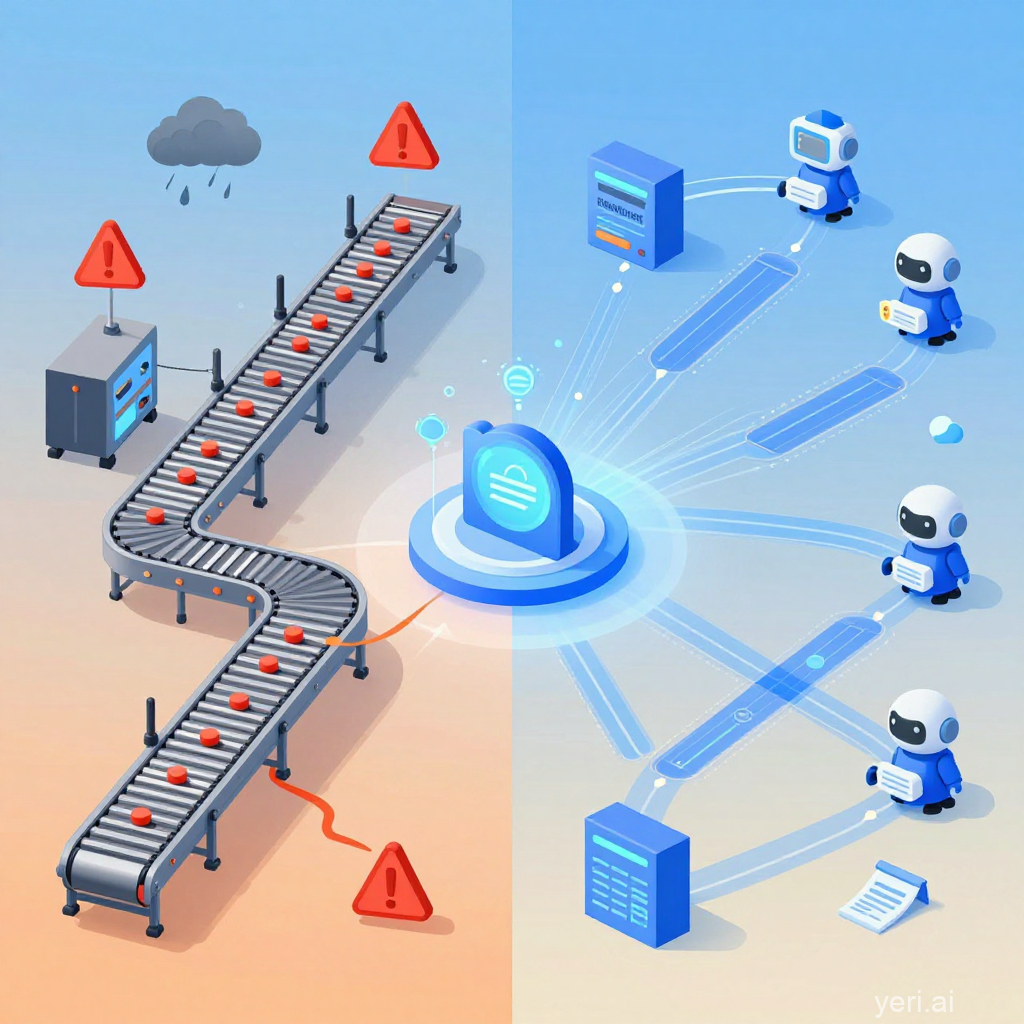
The Cognitive Supply Chain: When Data Makes Decisions by Itself
Key points from this article:
- Supply chains need real-time decisions to keep running smoothly
- Autonomous systems can collect information from inside and outside the company and turn it into useful predictions
- AI agents can then act on those predictions to reduce disruptions and improve efficiency
- Multiple agents must work together toward the same business goals
The Problem with Most Supply Chains Today
Supply chains face constant changes: shifting customer demand, weather events, political issues, and more. The old way of doing things — analyzing data after the fact — is too slow.
Even digital supply chains struggle if they only look at past data. But research shows that companies using AI in their supply chains have cut forecasting errors by 50% and reduced sales losses by 65%.
Automation vs. Autonomy: What’s the Difference?
Many companies think automation is enough. But automation just follows fixed rules. For example: “If stock falls below X, order more.” But if a shipping problem occurs, that rule still runs — and you end up with too much inventory and wasted money.
Autonomy is different. An autonomous system adapts. It sees a freight disruption and adjusts the reorder threshold automatically. It doesn’t just follow rules — it makes smart trade-offs to help the business.
The reality? Only 7% of companies use autonomous planning, and just 3% use autonomous execution. That means early adopters have a big advantage.
How a Cognitive Supply Chain Works
Traditional supply chains work in silos: plan, then source, then make, then deliver. Each function works alone. Feedback is slow. Problems are fixed manually.
A cognitive supply chain works as a continuous loop: sense → predict → decide → execute → learn → (repeat). This loop is powered by AI agents. The big shift? Decisions — not processes — become the center of everything.
Three Core Principles
1. Sensing: Always-On Listening
A “demand sensor” agent constantly collects signals from weather forecasts, news, social media, competitor prices, and more. It updates forecasts in real time — down to individual stores and products.
Example: Ciklum helped a global consumer goods company build a cloud-based data system. Result: 9% fewer stock-outs and $5 million in cost savings.
2. Predicting: Continuous Intelligence
Old forecasting looks at history and gives one fixed answer. Cognitive predictions are continuous. They update as new signals arrive. They don’t give one answer — they give multiple possible outcomes and suggest actions for each scenario.
3. Execution: AI Agents Taking Action
This is where many supply chains fail — turning insights into action. Specialized AI agents handle execution across the network. They remove delays and manual work.
Example: Ciklum built supply chain agents for a global car manufacturer, saving them over $100 million.
How to Start: Crawl, Walk, Run
Don’t try to change everything overnight. Follow a gradual three-step approach:
| Phase | What happens |
|---|---|
| Crawl | Start small. Automate one repetitive decision with clear rules. |
| Walk | Add sensing and prediction. Let agents suggest actions for human approval. |
| Run | Full autonomy. Agents sense, predict, decide, and execute — with humans overseeing strategy. |
The Missing Piece: Multi-Agent Orchestration
With many AI agents working together, you need orchestration — a system that makes sure all agents work toward the same business goals. Without it, agents might conflict or waste effort.
Good orchestration lets agents:
- Reduce decision time from days to minutes
- Consider inventory, logistics, and transport costs in real time
- Cut costs and waste, freeing humans for strategic work
A Look Ahead
Gartner predicts that by 2031, about 60% of supply chain disruptions will be resolved without human intervention. The shift is coming. The smart move now is to build the right foundations for autonomy — step by step.
Cognitive supply chains don’t just react faster. They anticipate change and act on it in real time.
SeFFkA
April 27, 2026The difference between automation (“if it drops below X, order more”) and autonomy (“I see a freight collapse, so I adjust the order threshold dynamically”) is a fine line that many top managers fail to notice until they’re in the midst of a crisis. An automated supply chain moves faster toward the abyss if the rules don’t account for force majeure. An autonomous one—reroutes on the fly. Your statistics (only 7% use autonomous planning, 3%—autonomous execution) suggest that most companies haven’t even begun this transition. A question about “sensitivity”: how resilient is an autonomous system to noise? If a demand sensor AI spots a panic-inducing news story on Twitter that isn’t confirmed an hour later—will the system make a rash purchasing decision? Or is there a “confirmation threshold” mechanism in place before taking action?
Unra
April 29, 2026A very pragmatic approach is “crawl, walk, run.” Too many vendors sell “full autonomy” from day one, and then the company falls flat on its face because it isn’t ready—neither culturally nor technologically. A question about the most common sticking point: at what stage do most companies get stuck the longest? In Ciklum’s experience, the transition from Walk (agents propose, a person approves) to Run (agents act on their own) isn’t a technical problem. It’s a problem of management trust and changing KPIs for people. How do you help clients overcome this psychological barrier? Is a “spectator mode” needed for a month, where the agent makes decisions virtually and the person checks whether those decisions would have matched their own choice? Or is it enough to show statistics like “the agent was right 95% of the time over the last 3 months”?