
The New Reality: From Service Providers to Intelligence Partners
For decades, creative industries defined culture. Today, they must redefine themselves. Marketers are no longer just battling for attention; they are drowning in complexity. Every new platform, once an opportunity, now fragments operations, silos data, and strains the very ability to deliver unified growth.
The industry is caught in a “martech trap.” Over half of marketing leaders at billion-dollar brands admit they can’t track ROI effectively. Their tech stacks are a mess of disconnected systems, and as CMOs ascend to become chief architects of their company’s AI strategy, this fragmentation becomes a critical liability. When brands start building their own AI solutions, external partners don’t just face more competition—they face an operational environment that is harder to navigate and harder to prove value in.
Meanwhile, the tech giants are running away with the game. Google, Meta, Amazon, and others now command over a trillion dollars in global ad revenue, embedding AI so deeply into their platforms that agencies must either match their pace or become irrelevant. The result? Agency-client relationships are fracturing, with tenures shrinking to as little as two years. CMOs are no longer buying “execution.” They are demanding business impact. They need partners who can integrate deeply, lead with strategic technology, and accelerate growth—not just manage campaigns.
AI is Rewriting the Value Chain
We are witnessing a fundamental shift in how marketing value is created. In the past, innovation meant a new channel or a catchy format. Now, it means intelligence. It’s about how quickly a brand can orchestrate its operations—real-time data, end-to-end personalization, and AI-driven production that slashes costs and opens new engagement models.
We are moving to an AI-first operating model. Currently, AI powers about 17% of marketing operations; in three years, that number is projected to hit 44%. The winners in this new landscape won’t be those with the most tools, but those with the most connected infrastructure. Fragmented data isn’t just an inconvenience; it’s the primary barrier to proving marketing’s worth.
The Great Divide: AI-Enhanced vs. AI-Native
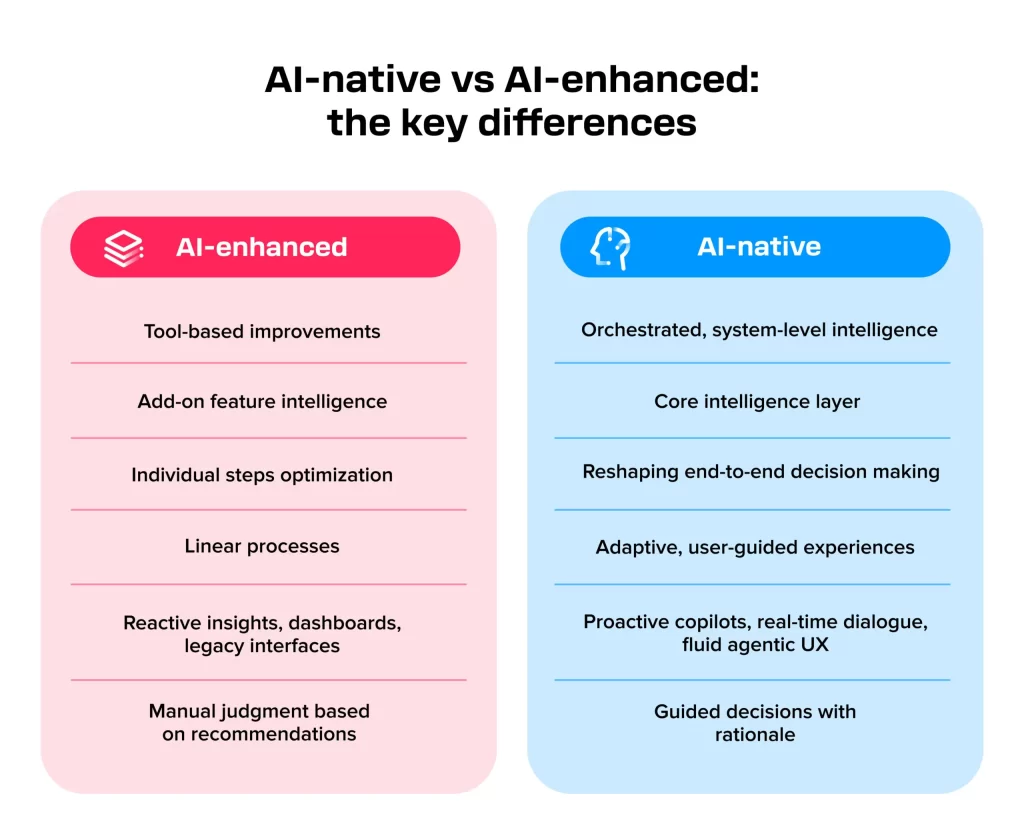
To navigate this, we must be brutally honest about technology. There is a critical difference between being AI-enhanced and being AI-native.
- AI-enhanced is a legacy system with AI bolted on. It automates a few tasks but leaves the operational friction intact—apps still need to be switched, data still needs to be reconciled.
- AI-native is built from the ground up with intelligence at its core. It learns continuously, handles any data type, makes autonomous decisions, and scales seamlessly.
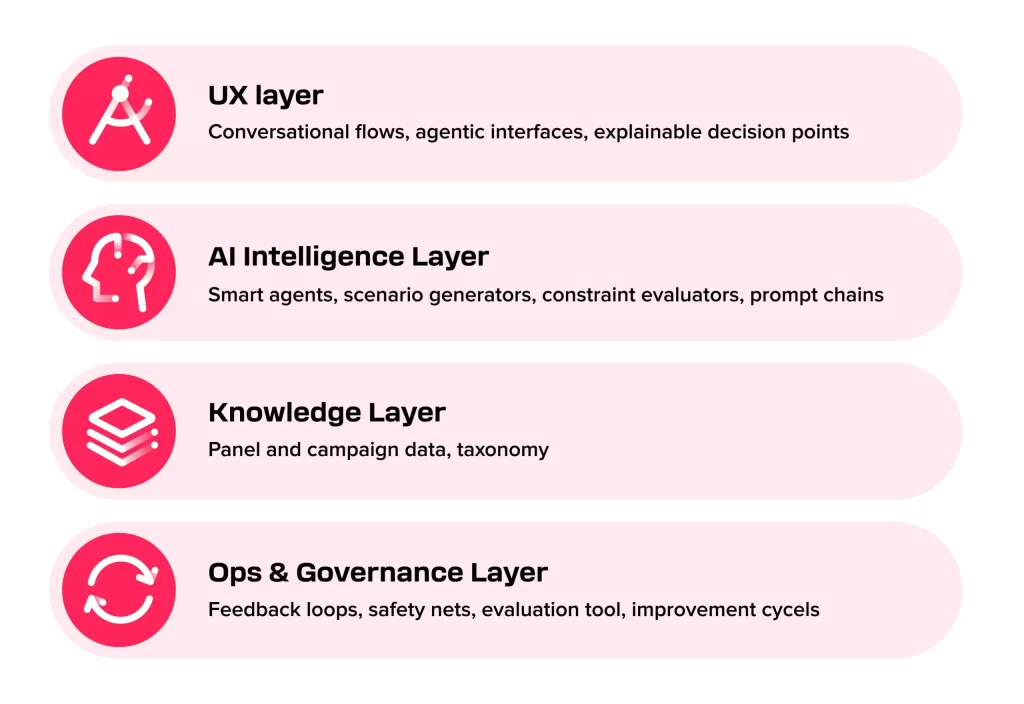
One is a patch; the other is a foundation. AI-native platforms are built on four architectural layers that enable this new operating logic:
- The UX Layer: Where humans and AI collaborate through conversational, agentic interfaces. A media planner doesn’t pull reports; they ask a question, and the AI delivers a complete plan with forecasts, freeing the human to focus on strategy.
- The Intelligence Layer: The engine room. This is where AI models generate predictions, optimize creative in real-time, and automate complex decisions.
- The Knowledge & Data Layer: The foundation. AI is only as smart as its data. This layer unifies fragmented ecosystems into a single source of truth, creating a proprietary “moat” that off-the-shelf AI can’t replicate.
- The Operations & Governance Layer: The guardrails. This is where trust is built—through traceable decisions, real-time audits, and security protocols that allow agencies to scale AI without risking client data or compliance.
The New Creative Collaboration
In an AI-native world, the human role doesn’t diminish; it becomes more critical. Our guiding principle is simple: Humans define the “why”; AI explores the “how.”
The linear production line is dead. It is replaced by an iterative loop:
- Human sets the vision: The creative director provides the emotional hook, the brand intuition, the moral compass.
- AI explores the possibilities: The AI agent analyzes fragmented data and generates multiple scenarios—optimal channels, budget splits, creative variations—that no human team could produce alone.
- Human refines and decides: The human acts as the final arbiter, asking the critical questions AI cannot: “Does this feel authentic?” “Will this resonate?” This ensures the output is not just statistically sound, but strategically brilliant.
This isn’t about replacement; it’s about amplification. It’s about freeing talent from the drudgery of data-pulling so they can focus on the magic of storytelling.
The Future: Defining Indispensable Partnership
The next era won’t be won by deploying more software. It will be won by delivering integrated growth. The market is fragmenting, and CMOs are looking for partners who can unify it.
Success requires clarity: What is your defensible strategic value? How will you solve for integration? How will you map your internal maturity to the CMO’s growth agenda?
The bar is rising. The future of marketing is not just “always on”; it is always learning. The agencies, publishers, and platforms that anchor their strategy on business outcomes—and work backward to orchestrate people, process, and technology—will be the ones that define leadership in the AI-native era.