
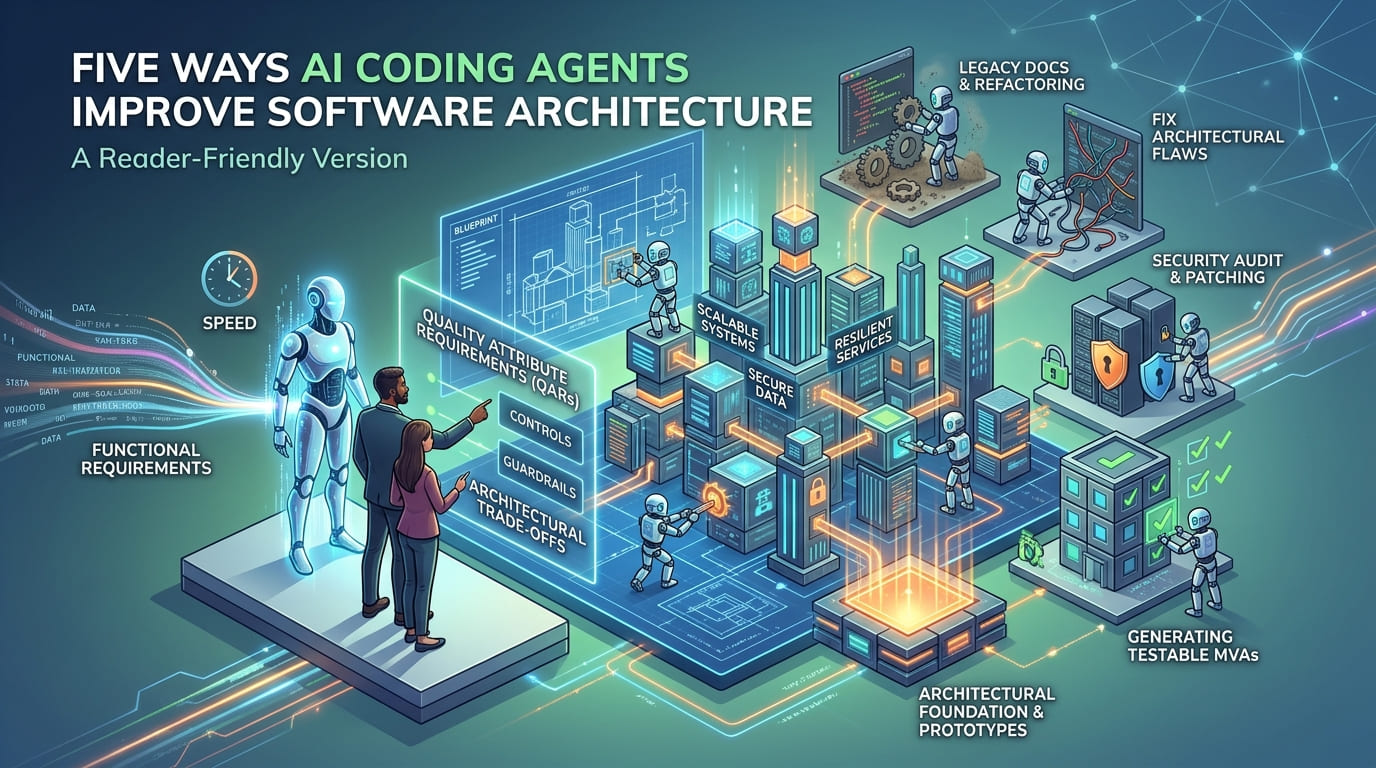
Five Ways AI Coding Agents Can Improve Your Software Architecture — A Reader-Friendly Version
AI coding agents are incredibly fast at writing code. That speed is useful, but it also creates a problem: it’s easy to lose control of quality. This is especially true for software architecture. If you only give an AI agent functional requirements, it won’t magically produce a sound architecture. You need to give it clear architectural goals, measurable quality attribute requirements (QARs), and explicit trade-offs. Then you need to test the generated code to see whether it actually meets those goals.
Using AI coding agents for resilient, scalable, secure systems is still very new. There’s no perfect playbook yet. But there are practical ways to get started without wasting time on random trial and error. Here are five useful approaches.
1. Use an AI Coding Agent to Document a Legacy Service Your Architecture Depends On
Modern systems often rely on old legacy services for specific tasks—like pulling policy data from a decades-old insurance system. The problem? These services often have poor documentation. If you don’t fully understand their logic and data, using them can be risky.
An AI coding agent can help by mapping the legacy service’s design, documenting data flows, scanning the code, and spotting potential issues. It can even suggest fixes. If the service is in really bad shape, the agent might help refactor it into something more understandable and maintainable. That reduces a major risk for your new architecture.
Example: A rarely used legacy service that reads from an IMS database might have hidden logic or security flaws. Those flaws could show up late in development—or worse, in production. An AI agent can help uncover them early.
2. Use an AI Coding Agent to Find and Fix Architectural Flaws
AI agents can do more than find security bugs. They can also find common architectural problems—like API design issues, insecure or inefficient interfaces, and violations of Domain-Driven Design boundaries.
Be specific about where you want the agent to look. For example, ask it to check whether any component is directly accessing another domain’s internal state or reusing code it shouldn’t. Just know that the AI will almost always find something. You’ll need experienced people to decide which findings actually matter.
This approach works best when the team provides clear architectural goals, measurable QARs, and well-articulated trade-offs. If you only give functional requirements, the resulting architecture will probably miss its quality goals. A helpful side effect: using AI this way forces teams to get much clearer about their trade-offs and what they’re willing to accept.
3. Use an AI Coding Agent to Perform a Security Audit
AI coding agents can be used maliciously, but they can also be used defensively. They’re especially useful for finding and patching vulnerabilities in open-source packages.
You can ask an AI coding agent to:
- Map the system design by tracing data flows and identifying risky files.
- Scan code for complex logic flaws across multiple files.
- Generate hacker-style scripts to stress-test your defenses.
- Create code patches to close security holes.
Important safeguards: limit the agent’s file access, mask sensitive passwords and secrets, keep it in a locked network environment, and require human code reviews before merging any changes.
Example: A client flagged several npm packages as risky. With an AI coding agent, the team evaluated the risks, updated two packages, replaced one, and left one alone because the warning was a false flag.
As AI gets more powerful in cybersecurity, using AI agents to find your own weaknesses before bad actors do becomes even more important.
4. Use an AI Coding Agent to Give Developers an Architectural Foundation
AI agents can help teams experiment fast and show users a prototype almost instantly. But without architectural guidance, those prototypes are usually throwaway work.
To fix that, direct and constrain the agent with specific, measurable architectural goals and clear trade-offs. Then use it to create pre-packaged shell applications that developers can build on. These foundations can include QARs, coding styles, database designs, APIs, preferred platforms, and frameworks—often in Markdown format.
Example: For a small React app, ask an AI agent to review your folder structure against modern practices. If it’s out of alignment, the agent can suggest or make changes. Always check that its recommendations fit your actual problem.
Another example: If your teams keep starting new apps with similar patterns, use GitHub templates. You can stub out common structures, create reusable AI skills, and build coding standards right in—so teams start off on architecturally sound footing.
A key lesson: describe what you want to achieve, not the exact solution you want generated. That means many unspoken architectural requirements now have to be made explicit, implementable, and testable. Coding gets easier with AI, but defining requirements gets much harder. The skill developers used to avoid—understanding and articulating requirements and constraints—becomes one of the most important skills to develop.
5. Use an AI Coding Agent to Generate Testable MVAs
A Minimum Viable Architecture (MVA) needs enough code to prove that it satisfies both functional requirements and QARs. AI coding agents can generate that code quickly—but only if the requirements are specified correctly.
Inspecting AI-generated code is important, but not enough. You need measurable tests to evaluate whether the architecture actually works. If the team has already provided QAR and trade-off information in the prompts, the agent can also generate test harnesses, test data, and test environment configurations.
There’s also a risk: the AI may not fully satisfy your QARs, and you may need to extend the MVA. To avoid surprise costs, include architectural change cases in your evaluation of the AI-generated MVA.
Conclusion
AI coding agents offer huge speed improvements, but they need effective guardrails. Software architecture is how you make sure quality goals are actually met. Teams need to give AI agents architectural context—goals, constraints, QARs, and trade-offs—so the output isn’t just fast, but sound.
AI coding agents are already valuable for architectural work, but they also introduce new challenges we’re only starting to understand. The suggestions above aren’t the final word. They’re a practical starting point for teams learning how to use AI coding agents to improve or develop their software architecture.
SeFFkA
October 2, 2026The biggest takeaway is uncomfortable but true: coding gets easier with AI, while defining requirements and trade-offs gets harder. That’s the skill teams now need to invest in.
vcdgyo
October 8, 2026The article flips the usual AI story. Speed is the easy part; the real challenge is giving AI agents enough architectural context and guardrails to produce quality work.
Rimus
October 14, 2026The legacy-service use case is underrated. AI agents can make old, poorly documented systems visible and safer—before hidden flaws cause problems in production.