
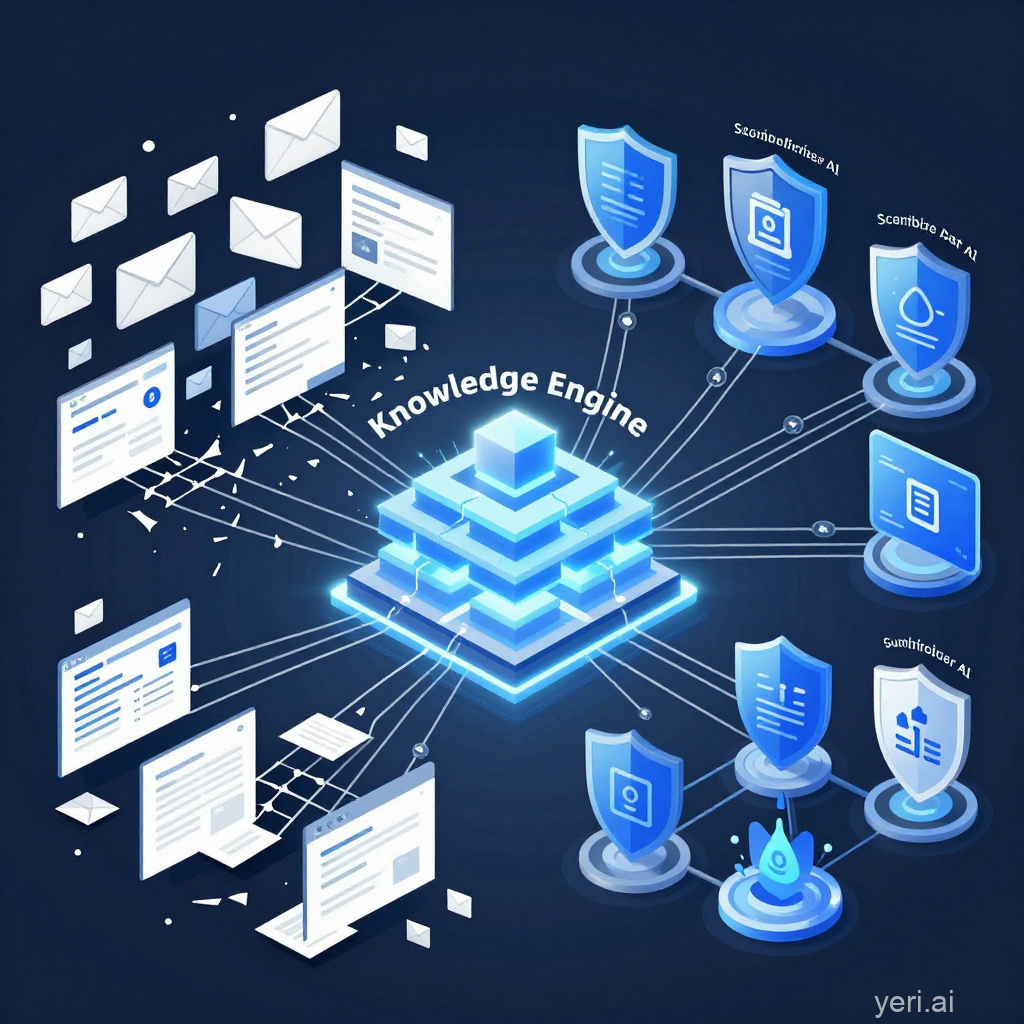
Inside PRODIGY: The Brain Behind Enterprise AI
Key points from this article:
- A governed knowledge layer separates AI as a nice feature from AI as real infrastructure
- A Knowledge Engine connects, organizes, secures, and activates company knowledge
- Enterprise AI agents need context and coordination, not just better prompts
- Compliance failures kill more AI pilots than bad algorithms
- Your foundation determines how long your AI strategy will last
The Problem No One Wants to Admit
Companies have moved past asking “Should we use AI?” The real question now is: “Why do so many pilots stall when we try to scale them?”
Here’s a familiar scenario: Your company ran 10 AI pilots in the last 18 months. Only 3 made it to production. Only 1 or 2 are actually used. The rest got stuck somewhere between proof-of-concept and the compliance team.
The irony? The knowledge AI needs to act on is scattered everywhere — email threads, old SharePoint folders, outdated wikis, messy Jira backlogs.
What’s missing is a coherent, governed layer that turns scattered knowledge into something AI can actually use, audit, and trust. That’s what a knowledge engine is. Without one, you just have expensive experiments.
What a Knowledge Engine Actually Does
A knowledge engine is not a database or a search tool. It’s an active, governed system that continuously connects raw company information to the AI agents that need to act on it.
It does four things at once:
- Connects everywhere — email, file stores, code repositories, ticketing systems, even old legacy systems (like COBOL-based banking platforms). AI can’t work responsibly if it only sees the modern layer.
- Normalizes and enriches — raw content becomes structured, tagged, and linked to business entities (customer, product, case, transaction). An email about a dispute becomes part of that dispute’s context.
- Governs access — inherits and enforces security rights. Sensitive content is hidden when needed. Rules are codified so AI respects the same constraints as human employees.
- Makes knowledge usable — not just retrievable. Retrieval finds documents. A knowledge engine understands context, resolves ambiguity, and serves the right information at the right moment in a workflow.
PRODIGY: Built for the Messy Real World
PRODIGY is Ciklum’s AI platform. Its Knowledge Engine is one of the most foundational pieces. The platform has three types of accelerators:
| Type | What it does |
|---|---|
| Technical | Speeds up AI delivery (including the Knowledge Engine) |
| Horizontal | Solves cross-functional problems (supply chain, HR, finance, IT) |
| Vertical | Goes deep into regulated industries (banking, healthcare, insurance, retail) |
The Knowledge Engine sits at the foundation of all three.
PRODIGY is also vendor-agnostic. Two years ago, GPT-4 ruled enterprise AI. Today, Claude has more than half the market. No ten-year contract works in a market that moves this fast. PRODIGY supports over 2,200 models from 114+ providers, on any cloud.
The Real Bottleneck Isn’t Code — It’s Everything Before It
Most time lost in AI development happens before a single line of code: discovery, requirements, understanding existing systems.
Here’s how the Knowledge Engine helps at each stage:
- Research phase — AI agents mine internal knowledge (emails, support tickets, logs) to find real problems, not hypothetical use cases.
- Design phase — Teams generate user stories and test cases grounded in actual discovery. Gaps get flagged early.
- Build phase — Developers stop digging through old notes. Constraints and decisions surface directly in their coding environment.
- Run phase — Monitoring agents track performance and user feedback, so the product keeps improving.
Where AI Goes Quietly to Die: Legacy Systems and Regulation
Most enterprise AI initiatives don’t fail dramatically — they suffocate slowly.
Legacy systems: The problem isn’t capability, it’s context. Old systems nobody fully understands anymore. The Knowledge Engine makes that institutional knowledge searchable and brings it into the tools engineers already use.
Regulated environments: The Knowledge Engine creates an audit trail that most AI systems lack. Every output traces back to its source. When a regulator asks how a recommendation was made, the answer exists — documented, not reconstructed.
The Question Every Executive Should Ask
AI platforms are everywhere now. Most work fine — until your environment proves too complex, too legacy-heavy, or too regulated for the default setup.
PRODIGY is built for what falls outside that default. For the insurer still running a policy system from 2004. For the health system where a data leak is a patient risk, not just a PR problem.
Ask whether your platform has a knowledge layer strong enough to survive contact with your actual environment — or whether you’ll be rebuilding it when the next wave of pilots hits the same wall.
StrikerJa
April 30, 2026The statistic—10 prototypes → 3 in production → 1–2 actually in use—is the pain point that almost all corporate AI programs keep quiet about. And the key point of this article is that it’s not a “bad algorithm” that kills projects, but the lack of a governed knowledge layer. We had a case: a brilliant LLM prototype for customer support crashed and burned against reality because, in production, it had to pull data from 14 systems with 7 different access levels and 3 outdated authorization formats. Without a knowledge engine to abstract this nightmare, every query turned into a 500-line if-else monster. Question: How does PRODIGY solve the problem of “delayed synchronization” of access rights? If HR terminates an employee at 10:00 AM, but their rights in the AD directory won’t be revoked until 2:00 PM—is there a risk that the Knowledge Engine will still be serving their documents to the AI agent until the next synchronization cycle?
SeFFkA
May 2, 2026The phrase about “legacy systems that no one fully understands” isn’t hyperbole—it’s the plain truth. I remember a bank where the core banking system was written in COBOL in 1988; the only developer who understood it retired in 2015, and the documentation consists of comments in German on printouts from the 90s. A Knowledge Engine that can “extract” patterns and logic from such a system (without rewriting it) is the only way to add an AI layer without undertaking a 10-year refactoring project. A technical question: how does your Knowledge Engine handle unstructured sources of “dead” institutional memory? I’m not talking about documents, but, say, five years’ worth of Slack conversations, where only half the messages have context, and the rest are “like that past case with Sber, remember?” How do you restore those references?
Unra
May 4, 2026“Most AI initiatives don’t fail spectacularly; they die a slow death”—a brilliant way of putting it. And in regulated industries, this slow process takes exactly as long as it takes for the compliance department to ask the first uncomfortable question: “Why did the AI recommend this particular client for a higher score? Show me the dataset and the logic behind that conclusion.” An audit trail isn’t an option—it’s a matter of survival. A clarifying question: How does PRODIGY ensure explainability at a level sufficient for a regulator like the ECB or HHS? Simply showing that the LLM generated tokens with a probability of 0.87 is not enough. Do you need to link the decision back to specific lines in the training data, or do you use a different mechanism (for example, retrieval-augmented decisions, where each decision documents the sources from which the context was retrieved)?